

The Cost of the Comforting Lie
On Louisiana v. Callais and a politics that won't look at itself.

The Story We Wanted to Believe
For about a decade now, much of the pro-democracy coalition has accepted a story that, on quiet reflection, none of us has ever been quite sure we believe. The story told most insistently by The Bulwark, The Dispatch, and the various Never-Trump remainder firms now runs roughly as follows: there was once a noble American conservatism. It had its Burke and its Buckley, its prudential temperament, its reverence for institutions, its anti-Communist resolve.
And then came Donald Trump, an interloper, who effected a hostile takeover. The racism, misogyny, nativism, and authoritarian impulse of the Trump era are therefore aberrations, or barnacles, hijackings, and late-onset infections. The body was healthy. The disease is recent.
I have wanted to believe this story for a long time. Many of us in academic and civil society spaces have entertained it as a working hypothesis, partly out of strategic generosity (coalition-building requires a certain hospitality to fellow travelers) and partly because the alternative is darker than most of us prefer to spend our weekends contemplating.
But as we approach the tenth year of the Trump age, I think the story has to be retired. Not merely because it has failed predictively, though it has, repeatedly, in ways that should embarrass anyone with a column. The deeper problem is that it actively prevents the kind of structural analysis this moment requires. The comforting story is not just wrong.
It is in the way.
The political theorist Corey Robin, in The Reactionary Mind, offers the diagnostic frame I think is by now unavoidable. Conservatism, in Robin’s reading, is not a defense of tradition or settled order in the abstract. It is a sustained reaction against emancipatory movements and a politics organized around protecting hierarchy from the felt threat of subordinate groups breaching its walls. Racism, populism, contempt for institutional convention, and the willingness to use political violence are not, on this view, accidents that happened to American conservatism on the way to its proper expression. They are constitutive elements and the means by which the movement does what it exists to do.
Rick Perlstein, who has spent four magnificent volumes excavating the American right from Goldwater through Reagan, has been making a parallel argument in a different idiom. In a 2021 interview with The Sun, Perlstein describes American conservatism as a movement designed to uphold hierarchy and authority against liberation movements, with the New Deal as the taproot of what conservatives have spent 80 years trying to reverse. Asked directly whether American conservatism could exist without white identity politics, his answer is unflinching:
“The experience of slavery and its racist aftermath has defined the history of American social movements, and I can’t name a time when the reaction against those movements wasn’t at the center of American conservatism.”
Perlstein is not a polemicist. He is the historian whose first book William Kristol — neoconservative William Kristol — praised for its fairness to its subjects. He has read the memos. He has logged the years in the archives. And his settled conclusion, after thirty years of looking, is that racism is not the mutation. It is the operating system.
Why This Has to Be Said Now
This is an uncomfortable thing to say to friends who have decided that decency is what unites us across the partisan divide. It does not feel collegial. It does not poll well at think tank dinners. But the reason it has to be said now, and clearly, is that the comforting alternative of the Never-Trump conditional, the long sigh that begins “if only the party hadn’t lost its way,” has become structurally incapable of metabolizing what is actually being done to American democracy. If you tell yourself Trumpism is an aberration, you read yesterday’s Supreme Court decision as a Trump-era distortion. If you understand that the conservative legal movement has been quietly working at this objective for forty-six years, you read it as the culmination of a project.
The Never-Trump frame is, in this specific sense, an analgesic. It numbs the parts of the picture that hurt to look at. And what hurts to look at, today, is what just happened to the Voting Rights Act.
A Sad Day for Voting Rights
Yesterday, the Supreme Court issued its decision in Louisiana v. Callais, and the headlines are doing it the courtesy of euphemism, describing it as limiting Section 2 of the Voting Rights Act and raising the bar. The more candid description is that six justices spent the morning performing an autopsy on a statute they refused to formally pronounce dead.
The Mobile v. Bolden Move
The mechanics deserve attention because the technical move is the political move. Section 2 of the 1965 Voting Rights Act, that provision that has done the practical work of voting-rights enforcement since Shelby County v. Holder gutted the preclearance regime in 2013, and now has for over forty years been understood to forbid voting practices that produce discriminatory results, regardless of whether anyone could prove a smoking-gun racist motive. That results test was not a judicial gloss. It was placed into the statute by Congress in 1982, in deliberate response to the Court’s 1980 decision in Mobile v. Bolden, which had required proof of intent and which Congress, on a bipartisan basis, explicitly overruled. The 1982 amendments are among the most legislatively intentional acts of correction in modern American statutory history. Congress saw the Court reach for a doctrine that would kneecap the Act, and Congress reached back.
Yesterday, a 6-3 majority authored by Justice Alito reinstated Mobile by judicial fiat. Section 2 was not formally struck down, which would have invited backlash, and these justices have learned the lesson of Roe. The Act remains, formally, on the books. Only the standard for proving a violation has been quietly raised to a level no plaintiff can reasonably meet. Plaintiffs must now show, in Alito’s phrasing, “a strong inference that intentional discrimination occurred.” In practice, this means producing evidence that legislators are constitutionally shielded from being asked to provide.
As Common Cause’s Omar Noureldin observed yesterday, lawmakers do not say out loud that they are drawing maps to dilute the political power of communities of color, and legislative privilege blocks the discovery that might prove they did. The intent standard is, in practice, a litigation killer. It asks plaintiffs to produce a recording of an official saying the slur, when the actual mechanisms of discrimination are housing patterns, literacy gaps, generational wealth, and the slow sediment of a hundred years of structured advantage.
Worse Than Shelby
This is being read tonight by every voting-rights lawyer in the country as worse than Shelby. Shelby (2013) was a federalism opinion dressed in the language of triumph. Chief Justice Roberts famously wrote that “things have changed in the South,” a sentence that has been falsifying itself ever since the ink dried, even in the living memory of my ninety-nine-year-old grandmother, who has lynchings as a thing that happened to people she knew. But Shelby left Section 2 standing as an after-the-fact remedy: slower and more expensive than preclearance, but a remedy. Every meaningful voting-rights victory of the last decade, including Allen v. Milligan in 2023, which is the case the Roberts Court itself decided just three years ago and which yesterday’s ruling silently overruled in everything but name, has run through Section 2.
Callais takes the remedy itself. And it does so, importantly, at every level: nearly half of all Section 2 cases since 1982 have challenged at-large elections in cities, school districts, and county commissions. Shelby made discriminatory voting laws easier to pass. Callais makes them nearly impossible to undo, anywhere. The result, in Louisiana specifically, in a state whose Black population is roughly 33 percent of the total (the third-highest share of any state), will return to a single majority-Black congressional district out of six.
The new arithmetic is not subtle.
Narrative Cowardice and Permission Slips
This is the structural picture inside which the 2026 midterms are now being conducted. And it is the picture that mainstream political coverage cannot, or will not, see.
Turn on any of the political shows tonight, and you will find the same generic-brand horse-race chatter:
“The generic ballot has narrowed.”
“Watch the Pennsylvania exurbs!”
“Democrats bullish in three Arizona pickups!”
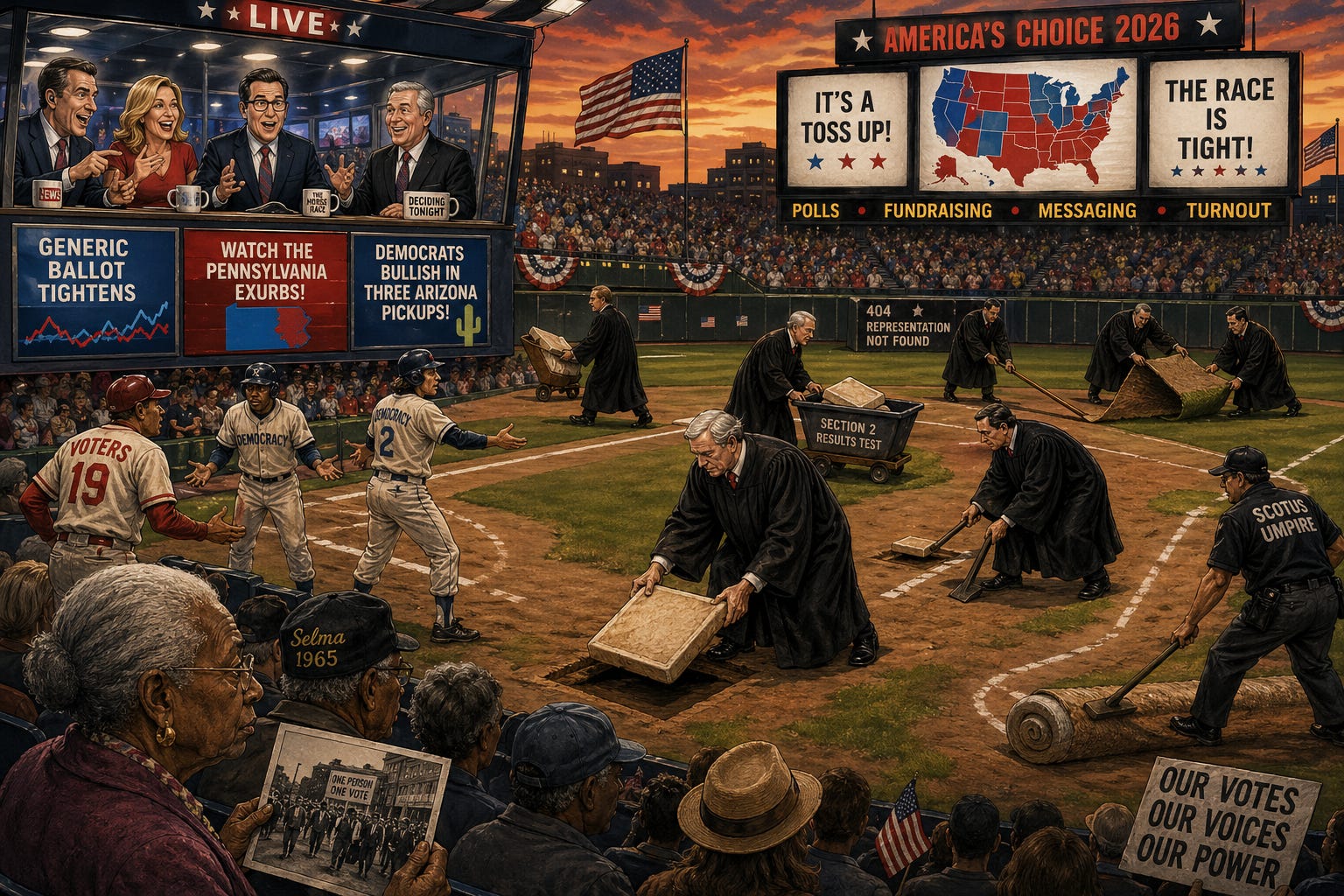
As though the rules of the contest had not been rewritten that morning by six people in robes. The pundits are narrating a baseball game while the umpires are quietly removing bases from the field.
They are doing this not because they are stupid; most of them know what just happened. They are doing it because the conventions of cable political analysis are built on assumptions that yesterday’s ruling simply voids. Horse-race journalism presumes a stable playing field on which the variables that matter are messaging, candidate quality, fundraising, and the ineffable national mood. Within that frame, you can have endlessly recombinable arguments about whether voters in Bucks County are more responsive to economic populism or cultural moderation, and the arguments feel substantive because everyone has agreed, in advance, not to look at the foundation. The foundation is the maps. And the law that determined whether the maps were drawn legitimately just got hollowed out.
To call this professional malpractice is to undersell it. It is something more specific: it is narrative cowardice. A willed refusal to look at the structural picture, because looking at it would require taking sides on a question the political class has decided is too partisan-coded to acknowledge out loud. Better to be safely banal than dangerously accurate. Better to book the same six consultants and run the same playbook segment than to say plainly, on air, that the central question of the 2026 midterms is no longer who voters prefer but whether voters’ preferences will be permitted to translate into representation. The pretense of neutrality is itself a partisan act. The bipartisan symmetry default (for example, punditry that says both sides will gerrymander, or that it is expected to benefit Republicans, but that Democrats have their own opportunities in Maryland and Illinois) is technically true in the way it is technically true that both rich and poor are forbidden to sleep under bridges. The asymmetry is the story. But asymmetry is harder to package into a Tuesday evening panel than “both sides are gearing up for a fight,” which has the great virtue of requiring no one to say anything that could be characterized as taking a position.
Fantasyland and the Permission to Not Reckon
Kurt Andersen, in Fantasyland, traced the long American tradition of magical thinking, the willingness, baked into the country from the start, to choose comforting myths over verifiable reality. American political journalism at the moment is operating squarely inside Andersen’s frame. It is producing a coverage product that allows its consumers to feel they are following the news without ever having to confront what the news means. The coverage works as therapy, not analysis. It is, to borrow Perlstein’s lovely formulation about Reagan, a permission slip or permission to not reckon with reality.
Reagan extended that permission slip to white America in the 1980s, telling them, with cinematic warmth, that the racial sins of the country had been settled and they could now relax. The cable news pundit class is extending a similar permission slip to the moderate Democrat and the cognitively dissonant centrist in 2026. The system is working. The election is fair. The maps are merely contested. There is nothing structurally unprecedented about what is happening. Have you considered the swing voter in Macomb County?
The Operating System
There is a temptation, when writing about American racial backlash, to reach for the metaphor of the Achilles heel, the vulnerability of an otherwise sound structure. I want to retract that metaphor. Backlash is not the wound the system suffers. It is the engine the system runs on. The W.E.B. Du Bois of Black Reconstruction, the Cedric Robinson of Black Marxism, and the Walter Johnson of River of Dark Dreams, all in their different ways, have argued that American capitalism was not merely tarnished by racial subordination but constituted by it. The cotton fields built the credit markets. The slave economy underwrote the early industrial North. The reaction against Reconstruction shaped the modern judiciary. The Southern Strategy redrew the parties. Shelby and Callais are not departures from the American operating system. They are it, executing as designed.
This is the harder thing the comforting story will not let its tellers see. The Never-Trump frame requires that the structural rot be recent, contained, exogenous — a Trump problem, not an American one. But the Roberts Court is not Donald Trump’s instrument. It is the considered work of a forty-year movement whose intellectual scaffolding was built by Federalist Society lawyers, conservative legal scholars, and yes, some of the columnists at the magazines now expressing dignified concern about the state of our democracy. The judges who handed down Callais yesterday were vetted, championed, and confirmed with the active support of people now writing earnest essays about the loss of conservative principle. There has been no hijacking. There has only been a project, executed patiently, in front of all of us.
I write this not to indict the Bulwark reader or the cognitively dissonant centrist or the moderate Democrat with a tasteful subscription to The Atlantic. I write it because the structural picture is now urgent enough that the comforting story has to be set down. We do not have the luxury of pretending the Voting Rights Act was undone by a deviation from American conservative norms. It was undone by American conservative norms — by a movement that has, as Robin and Perlstein have been telling us for years, always been organized around exactly this objective. To absorb that is hard. To refuse to absorb it, at this point, is complicity dressed in the costume of decorum.
My grandmother, who is ninety-nine, has lynchings in her living memory. The era she remembers is not closed. It is being re-engineered, with cleaner language and better lawyers, in front of us. The honest political coverage of the 2026 midterms will be the coverage that says so.
Everything else is therapy.

💯 as usual Steward...The Right have nothing but excuses left!!!
Excellent breakdown.