

Author’s Note: The piece I had intended to publish tonight, on the subject of Minneapolis in the broader context of American statehood and civic infrastructure, will instead be published on Monday. I want to give myself some time to marinate on the ideas and perspectives that I’m weighing. Here are some brief thoughts, really just me trying to work through my own thinking on the subject.
I have to say, I’ve been responding pretty viscerally to the constant refrain that “this isn’t the country I grew up in.” Not because I don’t understand the sentiment behind that statement, but because I think there’s often a failure to account for state-sponsored violence in minority communities, as well as the austerity that can set in as a result of losing funding and tax bases in these communities that become starved of life. Sometimes, my reaction to this statement is just one of frustration, because, quite frankly, this country has been recognizable to many Americans for quite some time.
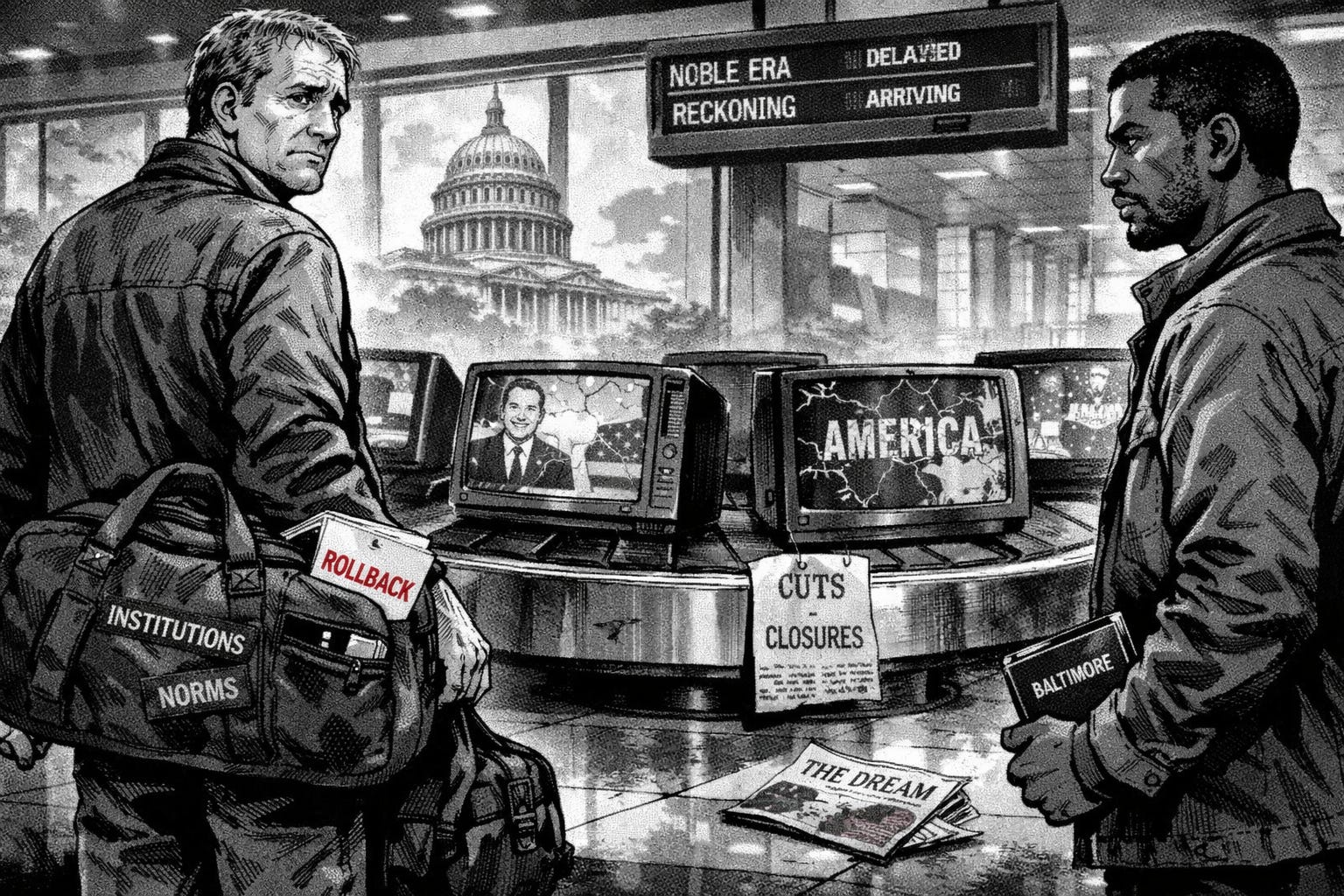
But I want to get into why I have that reaction, because, quite frankly, this isn’t just a political argument but a personal one, and one that’s also generational. I didn’t grow up in the Cold War. I was born into a culture of ironic cynicism about anything that was branded as America, and I’ve seen the rollback of civil rights that was my only real attachment to the idea that America was worth believing in, in spite of everything that I experienced as a Black male growing up in Baltimore.
Now, with this Trumpian rollback, I’ve come to see America more like a well-marketed empire rather than a land of ideals. And I don’t mean that the rollback has caused me to see America this way. I mean that it has clarified this way of seeing America. It has made it harder to pretend that this has all been the truth all along.
So when people say, “this isn’t the country I recognize,” what I hear beneath that is, “this isn’t the country I was taught to recognize. Or even, “this isn’t the country I needed to recognize.” Not because those people are bad, but because the marketing has been so good that it feels like reality. And so, for those people who have bought into the ideals, this is a bad thing. It’s a bad thing because it may reveal something worse. That perhaps they’ve been dupes in a marketing scheme all along. Perhaps this has been a marketing scheme that has been manipulating people before them.
If you need a different way to say this, I think there’s a way to say this that doesn’t dismiss what other people have always had to deal with.
Maybe one can say: “I’m realizing I didn’t understand the country I grew up in.”
Or one can say: “I’m seeing what other people have been living with.”
Or even say: “I was protected from certain truths, and that protection is breaking down.”
That isn’t shame but the beginning of historical literacy.
The Vietnam Homecoming Parallel
A significant portion of my intellectual pursuits in my 20s (and now my early 30s) has been influenced by the study of media literacy, Cold War cultural production, the rise of the New Right politics, and the fall of New Deal and Great Society idealism. Naturally, this has led me to be interested in the rise of the Never Trump Republicans and the reactionary centrist liberals and how they have responded to this moment. Much of the time, this has led me to a place of disillusionment regarding the commentary of the former group in particular, not because I think they’re necessarily bad people, but because I think many of them can’t bring themselves to admit that maybe there never was a before that was particularly noble. That Trump is simply the next logical step in the progression of the excesses and blind spots that have long been part of the system.
Perhaps this has simply been the nation all along, and the legacies of racial segregation, the rise of wealth gaps, and the rise of capitalism need to be honed in on rather than the Cold War notion of a noble nation of good standing battling against the evil authoritarian regimes that have long been supported in the shadows by the power centers of the United States.
As I have been studying this group of Never Trump institutionalists (and, as a side note, I am also a part of this institutionalist tradition, and I also sadly believe in institutions), I think I have drawn some parallels with this group that are similar to the way I think Vietnam veterans who enlisted in the war felt as they came back to the United States from the disillusioning experience of the battlefield. An experience in which they realized that perhaps all of the late-40s through the early-60s anti-Soviet propaganda they had been sold on throughout their lives may have been, at least in part, propaganda.
Propaganda that was good enough to get people on board.
Propaganda that was good enough to leave people psychologically adrift, as the story they had been sold on had no way of surviving the test of reality.
Or perhaps the homesteaders of the late-19th century, who were sold on the idea of fertile rains and plentiful land, only to find a crusty, drought-ridden corner of the country, as the speculators had bought all of the good land, while the promise of the rains was merely a good piece of propaganda sold to the downtrodden and naive.
And thus, we have a group of people who grew up in a similar type of propaganda, which sold them Cold War triumphalism, sold them on the United States as a benevolent empire, and sold them on the idea of the pain of the American empire as something that occurred in some other place, rather than within the continental United States. And thus, we have this reaction, which I am working through, as perhaps this is all untrue, perhaps I am merely young, perhaps I merely never saw the blinding lights of the decades before I was born, or even within my single digits.
So that’s what I wanted to share with you all as I prepare this essay for Monday.
Is the American dream and democracy simply the result of good marketing for the age of mass media and industrial revolutions?
Are Americans simply marks of a really good story with policy and generational tales of imagined racial, gender, and religious hierarchies that keep the labor force divided and compliant?
I know it’s a dark picture, and it’s not the happiest place on earth (there’s a marketing machine for that if that’s what you’re looking for). I’m just being brutally honest about what shouldn’t be disillusioning, but clarifying times.