

Who Gets to Be Taken Seriously?
What Ye and Sarah Longwell reveal about a political culture losing its footing.

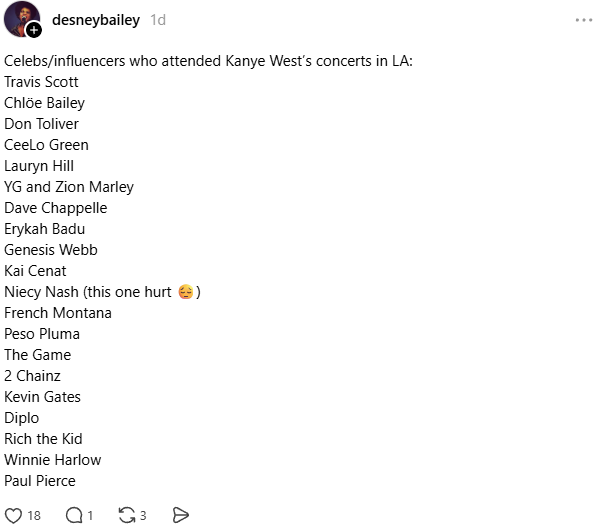
There has been a wave of backlash over the people who attended or praised Ye’s recent Los Angeles concerts, and Pepsi’s decision to pull its sponsorship from Wireless Festival in the United Kingdom after his booking as a headliner was the right one. Ye has disgraced himself and others through an open embrace of antisemitism that has included open praise for Hitler, swastika-themed imagery, and other Nazi-associated symbolism. That is not a minor controversy or an edgy lapse in judgment. It is a deliberate moral collapse, and institutions are right to stop pretending otherwise.
American society is in a dangerous place when it struggles to generate enough social pressure to say, with clarity and conviction, that this political and cultural direction is unacceptable. Celebrity culture reveals that weakness in bright neon. There has been intense scrutiny of the guest list, and the orbit around Ye’s Los Angeles shows. Lauryn Hill was widely reported as appearing at the concert, alongside Travis Scott, CeeLo Green, North West, and Bianca Censori. That matters because fame does not dilute moral responsibility.
It magnifies it.
When influential people continue to stand near a public figure who has trafficked in antisemitism, they help normalize what should remain beyond the pale.
Americans from one marginalized group cannot ignore hatred aimed at another group and then expect to build a more equal society. That bargain never holds. It only deepens the rot. What we are seeing is not just celebrity excess, but a broader bread-and-circuses culture in which spectacle crowds out civic seriousness, and attention is forever pulled toward flash, noise, and self-mythology. The result is a hollowed public life, one in which moral lines blur because too many people are still mesmerized by the lights.
Ye has also become a revealing example of how public life mishandles the intersection of mental health, fame, and ideological hatred. In his January 2026 apology, he tied his antisemitic conduct to bipolar disorder and a manic episode, but that explanation cannot be allowed to function as an all-purpose pardon. Mental illness deserves care, treatment, and seriousness. Antisemitism deserves clear and forthright condemnation. The two truths must be able to stand in the same room at once. To blur them together is to fail both people living with mental illness and the communities targeted by hate.
That is why this story matters beyond one man’s latest spectacle. The continued willingness of prominent celebrities, fans, and fellow travelers to help restore Ye’s public aura reflects a deeper American failure to treat antisemitism as a civic emergency rather than a celebrity subplot. A country that wants to honor the struggles of those who fought for civil liberties and human rights cannot afford to look away when hatred is repackaged as provocation, genius, or entertainment.
But this failure is not confined to celebrity culture.
It shows up just as clearly in politics, where outrage is often selectively validated, where some forms of moral witness are dismissed as irrational, and where the boundaries of acceptable concern are quietly policed in the name of strategy.
If we cannot draw firmer lines in our cultural life, we should not be surprised when our political life struggles to draw them either.

It’s Not Just a Temper Tantrum
Note: These are not equivalent situations; one is explicit hatred, and the other is a matter of political judgment. But they reveal a similar weakness in a culture that struggles to apply moral clarity consistently.
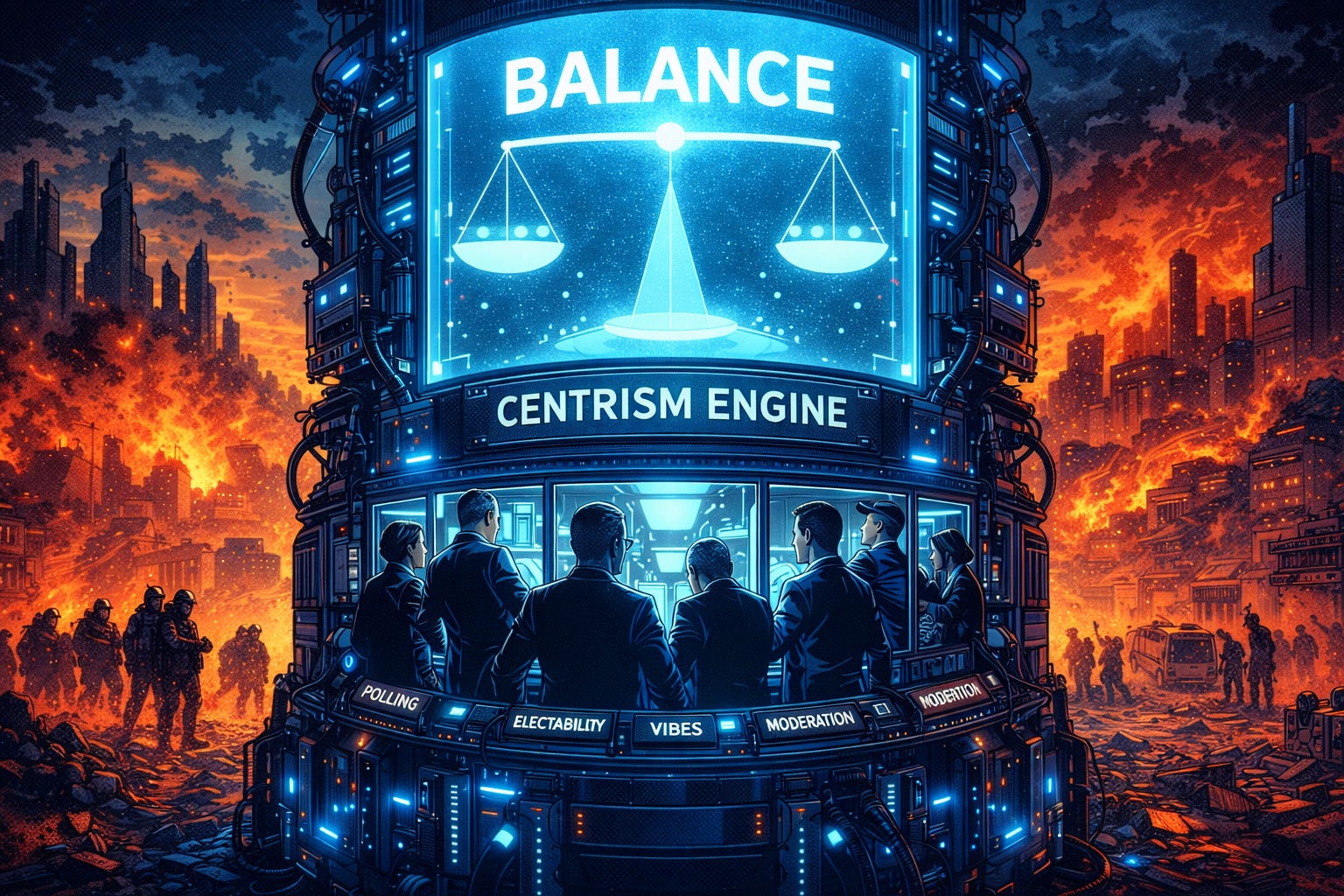
There’s a wave of backlash building around Sarah Longwell, and it’s not just another fleeting internet pile-on.
Clips are resurfacing, critiques are sharpening, and a familiar question is re-emerging: why are some of the loudest voices advising Democrats still so quick to dismiss the very voters the party needs to keep? One widely circulated example traces back to early 2024, when Longwell characterized outrage from Muslim and Arab Americans over U.S. policy in Gaza as a “temper tantrum.” That moment has come back with force not just because of what was said, but because of what it revealed.


That kind of posture is especially troubling because public concern over Gaza was not fringe or invented. By early 2024, major reporting showed deep anger among Muslim and Arab American voters toward the Biden administration’s handling of the war, especially in key states such as Michigan. It is also more accurate to say that UN experts and officials warned of genocidal acts or genocide risk, rather than claiming the United Nations had definitively ruled that a genocide had occurred.
As someone who followed The Bulwark closely and even recommended it to progressives who often looked at that suggestion sideways, I have long been skeptical of its ability to tell the Democratic coalition how to win without fully reckoning with the role many of its intellectual forebears played in building the political and media architecture Trump later weaponized. Whether one draws a straight line from Reaganism to Trumpism is partly interpretive, but it is hard to deny that the modern conservative movement normalized racial backlash, punitive nationalism, and elite impunity long before Trump stripped the euphemisms away.
I used to be more forgiving of Longwell than I am now. After the 2024 strategy of triangulating toward right-leaning voters failed, too many voices in and around the anti-Trump center spent 2025 blaming trans people, Arab Americans, pro-Palestinian Jews, and other marginalized constituencies for making swing voters uncomfortable, instead of confronting the deeper failures of elite strategy. Longwell’s own rhetoric often drifted into that lane. In a December 2025 interview, she said Democrats needed to “get their heads out of the college faculty lounge and start thinking about people’s jobs again,” a line that clearly echoes the familiar “Democrats are too woke” frame.
And this was not just her.
The broader Bulwark ecosystem kept returning to versions of that argument. In late 2024, Jonathan Cowan wrote in The Bulwark that voters’ association of “woke” attitudes with Democrats had hurt the party and warned against “faculty lounge pieties.” In March 2026, Bulwark contributor Steve Schale wrote that focus-group voters described Democrats as too “woke,” too “weak,” and too focused on niche social issues, and he argued Democrats must “never again adopt ‘Abolish ICE’ messaging.”
To be fair, The Bulwark is not entirely uniform on this point. Jonathan V. Last explicitly pushed back in April 2025 with “Dear Democrats: STFU About ‘Woke,’” arguing Democrats should focus less on rebranding around anti-woke signaling and more on disqualifying Republicans. That matters because the internal tension is real.
That’s why the backlash to Longwell feels different.
It isn’t just about one comment or one strategist. It’s about growing impatience with a political class that still believes it can define the boundaries of acceptable outrage, even as it loses its grip on the audience itself.
The question isn’t whether voices like Longwell’s belong in the coalition. It’s whether a coalition built on dismissing moral witnesses, alienating its own base, and clinging to outdated instincts can actually survive the moment it claims to understand.
Because at some point, the problem stops being the messengers you’re trying to push out, and becomes the message you refuse to rethink.


The likes of Ye and Mark Robinson and in fact all MAGA blacks and even conservative blacks leave me scratching my head.
Conservatism has a straight line route of travel from feudalism, to ante bellum south to MAGA and the Republican party today. It is classism, and that means it is racist.
More horrified am I by the existence of black NAZI's, I can only assume that they suffer from some kind of mental disease or defect.
Adolph Hitler was not just an antisemite by had a thing about , die schwartzen
And the American flavor of NAZI's are avowedly racist. The Turner Diary was about a race war, instigated by white nationalists to eliminate the black population.
In it one page describes an L.A. market where the blacks are selling human meat.