

What the Storytellers Cannot Say
On pundits failing upward and the marginalization of political imagination.


The conventional wisdom among the commentariat is that because of inflation and anti-incumbent energy internationally, Democrats were destined to lose in 2024. There are reasons to hold onto this specific truth, especially the part about anti-incumbent sentiment. But the language of political obsessives and political communicators overlooks a crucial source of discomfort about the election. The person who won was someone who openly and brazenly engaged in anti-democratic activities.
Yes, the punditocracy will apologize for voters who weren’t politically literate, which is warranted to a degree. But the violence of January 6th and the rhetoric of othering fellow Americans were plain on the record. People still chose to go in that direction.
The real problem is that the standards have fallen so low, and the coded hate has been so normalized over decades of GOP campaign strategy, that our political communicators are bound and determined to recycle old turn-of-the-millennium verbiage rather than meet this particularly dark — and revealing — moment.
That is pretty much my position, and not new to consistent readers of Stew On This. But the personal stakes of the argument are worth saying out loud, because they are baked into the images at the top of this piece.
I went through the political communications meat grinder at American University and in my early career, and I came out of it with a distaste for the pundit culture and the reactionary centrist corporate political storytellers it produces. That distaste was not abstract. I watched the machine work on people who looked like me. The pipeline is set up to take young people who arrive at its doors with ideas, passion, and a sense of public service (justice, equity, and democracy or the words that move us in our twenties) and to process them into the figures we see on cable who are identically dressed, identically sourced, identically practiced in the art of saying nothing while seeming to say something.
The Storyteller Machine strips away context, history, rage, solidarity, imagination, and moral clarity, and replaces them with focus groups, triangulation, brand message, centrist tone, voter targets, and electability. The pundits at the end of the conveyor are the ones who survived the processing intact. The people who didn’t like the ones who refused, or whose analytical instincts ran too structural to be sanded down, are not on cable.
They are on Substack, quiet, or out of the discourse entirely.
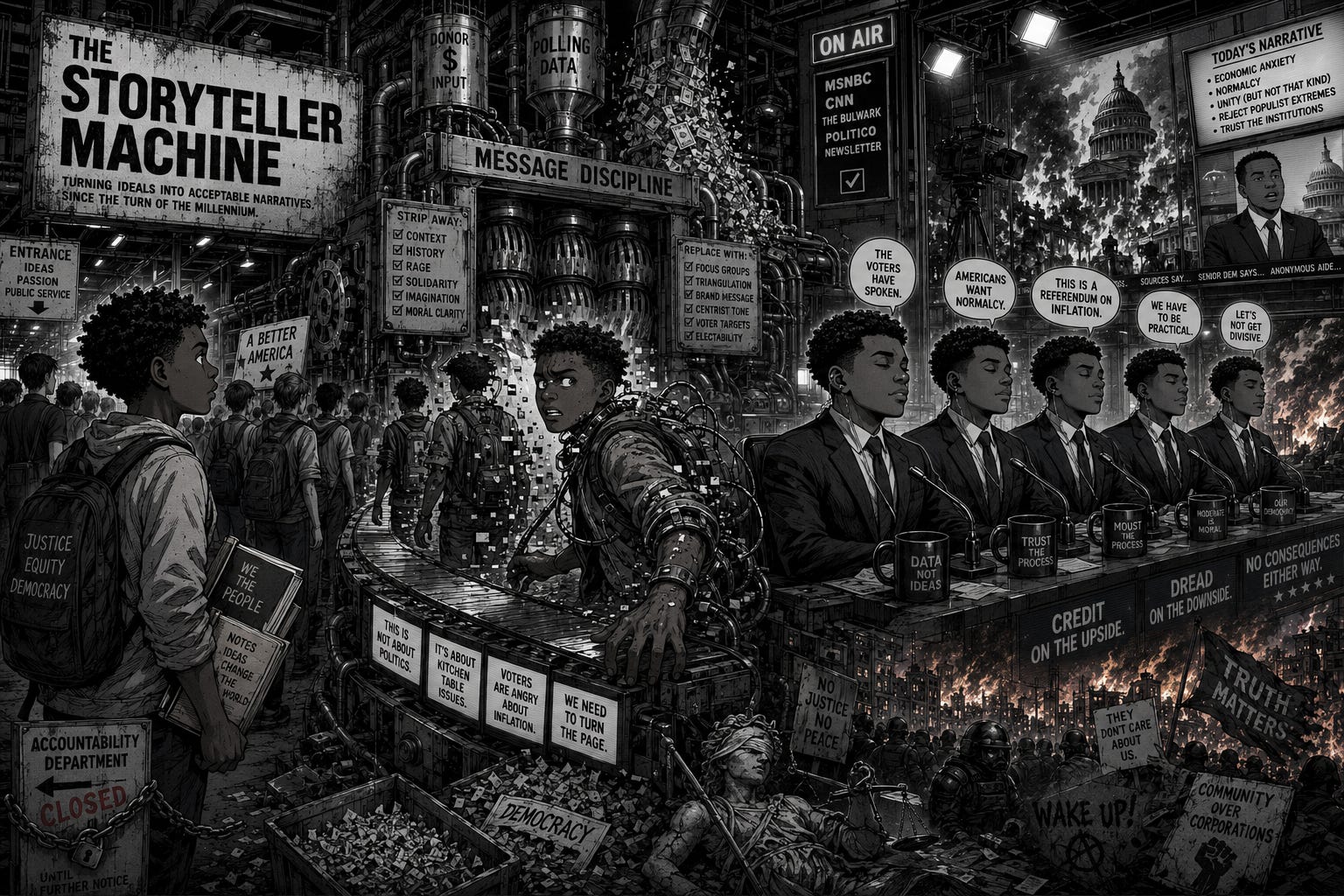
Take David Sirota’s observation from April: at the end of the 2024 campaign, the Bulwark crowd was thrilled they’d succeeded in convincing Kamala Harris to close on their anti-populist centrist message, and they worried that if she lost, it would be their fault. She did lose. It was, in some real measure, their fault. They are also still everywhere on the same shows, the same columns, with the same authority. The worry was not unfounded; the accountability simply never arrived. That is the structure of the storyteller class. Credit on the upside, dread on the downside, no consequences either way.

The episode of Reality Checking the Bulwark that will be released this evening looks at one of the machine’s longest-serving products, Charlie Sykes, and asks how someone who helped engineer the conditions for Trumpism in Milwaukee for more than two decades is now sold to a different audience as the cure for the disease he helped cultivate.
What is being marginalized, when the machine works as designed, is not just language. It is the political imagination, that capacity to think arrangements other than the present ones, to historicize what the pundit class insists is permanent, to refuse the false choice between “what voters want,” as measured by polls written to confirm the storyteller’s prior assumptions, and what voters might actually be capable of when addressed as citizens rather than as targets. The storytellers cannot describe what is happening because describing it accurately would dissolve the professional authority they built by describing the last era. And the deepest injury is not what gets stripped from the news cycle. What gets stripped from us is the sense that other futures are even thinkable.
The political imagination has been marginalized, not killed. Until we recover it, we are doomed to repeat history, and the worst has yet to come.
Happy Friday.

In the pseudo horror series "From" currently playing, a woman, already victimized by the evil agency that control this pseudo community, is, under the agencies influence, building a golem, a man of clay, that she says will protect the good people from the evil force. Why they don't see that she is building this evil is beyond me, but that is the script writers, two dufus who wrote the series Lost and couldn't bring themselves to end their cash cow, so they kept jumping shark after shark, and they are at it again.
But I stray,, this golem is a product of evil, not a protector.
A golem, for the uninitiated, is a rabbinical tale about a man of clay, that came to life when it's name was mentioned. A way of informing us that nothing exists until we name it, and thus bring it into existence. There is truth in that.
A worthwhile theme. An actionable suggestion. Thank you.