


Author’s Note: This essay is part of a longer process of rethinking how I understood the Trump era while living through it. Like many people, I relied on frameworks such as coalitions, norms, and institutional resilience, which once felt historically sound. Over time, those frameworks revealed their limits. This piece is not written from a place of certainty, but from sustained observation, lived experience, and a willingness to revisit assumptions that no longer hold. If democracy is to survive, our thinking has to remain flexible enough to confront uncomfortable truths, especially when they implicate the stories we once found reassuring.
As the year comes to a close, I’ve been thinking less about Donald Trump as a person and more about what my own understanding of his rise has revealed over time. Not just about him, but about the stories we told ourselves to survive his first term.
When Trump first entered office, I interpreted the moment through the long arc of American political coalitions. That framework wasn’t sentimental, but historical, as our story is full of parties fracturing, alliances shifting, and strange bedfellows emerging. So when Never Trump conservatives recoiled from the GOP they no longer recognized, I treated their bewilderment as sincere, and potentially useful.
From where I stood, though, as a Black person shaped by civil rights history and double consciousness, the reactionary energy powering Trumpism was neither new nor confusing. It was legible, it had precedents, and it had a long history of racial terror. But still, I assumed the difference was simply one of vantage point.
I’m no longer sure that generosity was warranted.
Because bewilderment has an expiration date, and Trump gave the country plenty of moments where confusion should have given way to recognition.
When he launched his campaign by calling Mexican immigrants criminals and rapists.
When the Muslim ban was signed and airports were filled with detained families and volunteer lawyers overnight.
When Charlottesville produced chants of “Jews will not replace us,” followed by presidential moral equivalence.
These were not subtle signals. They were clarifying events. And yet, large segments of Never Trump conservatism continued to frame Trump as an aberration rather than as a revelation, an exposure of what had been carefully normalized for decades.
The willingness of Never Trump conservatives to remain in coalition for so long with political heirs of Jim Crow, the Comstock Act, queerphobia, and religious bigotry tells us something uncomfortable. It reveals either profound intellectual blind spots or willful denial. You cannot claim to know this country while treating the lived histories of a major plurality of its population as optional footnotes, as if America’s story were best understood through the soft-focus lens of a Disney Channel suburb.
During Trump’s first term, I often argued there was a straight line from Ronald Reagan to Donald Trump, and that Trump simply ripped the mask off. I still believe that. What I question now is the usefulness of endlessly bashing Trump or his voters without grappling seriously with the machinery that produced them. Trump did not invent the weaponization of racial grievance, moral panic, or religious nostalgia. He inherited a fully stocked arsenal.
Some Never Trump conservatives have gestured toward this reckoning. But too often, it stops short of consequence.
Instead, discourse became obsessed with “normie Republicans” and “normie Republican voters,” a fixation that monopolized strategy discussions at the end of Trump’s first term. The leftover energy was then deployed downward: scolding marginalized communities for speaking “too emotionally,” scapegoating trans people as electoral liabilities, and equivocating over whether overturning Roe v. Wade would really matter.
We now know the answer to that last question.
During the Biden years, this pattern calcified. Democratic politics became trapped responding to focus-group feedback that reflected the success of right-wing disinformation rather than organic public concern. “Defund the Police” was treated as proof of left-wing extremism even as police budgets rose and people rarely claimed that motto. Trans athletes became a national obsession while abortion rights were discussed as if they were permanently secured by vibes alone. “Working-class voters” became shorthand for white voters whose Fox News media diet was politely ignored.
This is not theoretical for me. At Media Matters for America, I watched Fox News talking points get laundered daily and softened, reframed, and reintroduced into mainstream discourse by figures who insisted they were the reasonable center. Many of my colleagues believed this laundering was more dangerous than overt extremism because it created false history in real time, then held Democrats hostage to narratives built on bad faith. When a party is forced to respond to disinformation as if it were neutral data, it forfeits the ability to lead.
Now, in Trump’s second term, I am less preoccupied with Trump as an individual aberration. I am far more concerned with what his rise and return reveal about a political center that never fully reckoned with the past. A center so committed to nostalgia that it mistook denial for moderation.
Today’s pro-democracy conversation remains stalled by claims that “this isn’t real conservatism,” or by endless quotations from swing voters repeating Fox News scripts without naming the propaganda operation behind them. The result is an uninspiring politics that tone-polices those most impacted by reactionary policy while clinging to a static memory of America that never truly existed.
This isn’t about purity tests or ideological gatekeeping.
It’s about historical honesty.
A democracy that refuses to remember itself clearly will keep mistaking revelations for surprises and treating structural danger as a temporary detour.
These are not grievances from 2017. They are lessons we keep refusing to learn.

The Cost of Nostalgia Politics
What became clear during the Biden years is that the failure to reckon with the past was not just intellectual, but instead, institutional.
The political center that emerged after Trump’s first term was shaped less by democratic renewal than by exhaustion. Its overriding goal was stabilization, not transformation: calm the temperature, restore norms, return to a familiar soundtrack. This instinct is understandable, and it is also deeply insufficient.
Because the institutions that shape American political storytelling, legacy media, donor networks, and campaign consultants are structurally allergic to naming disinformation as disinformation. Their business models depend on access, balance theater, and the illusion of a persuadable middle that can be nudged without being confronted.
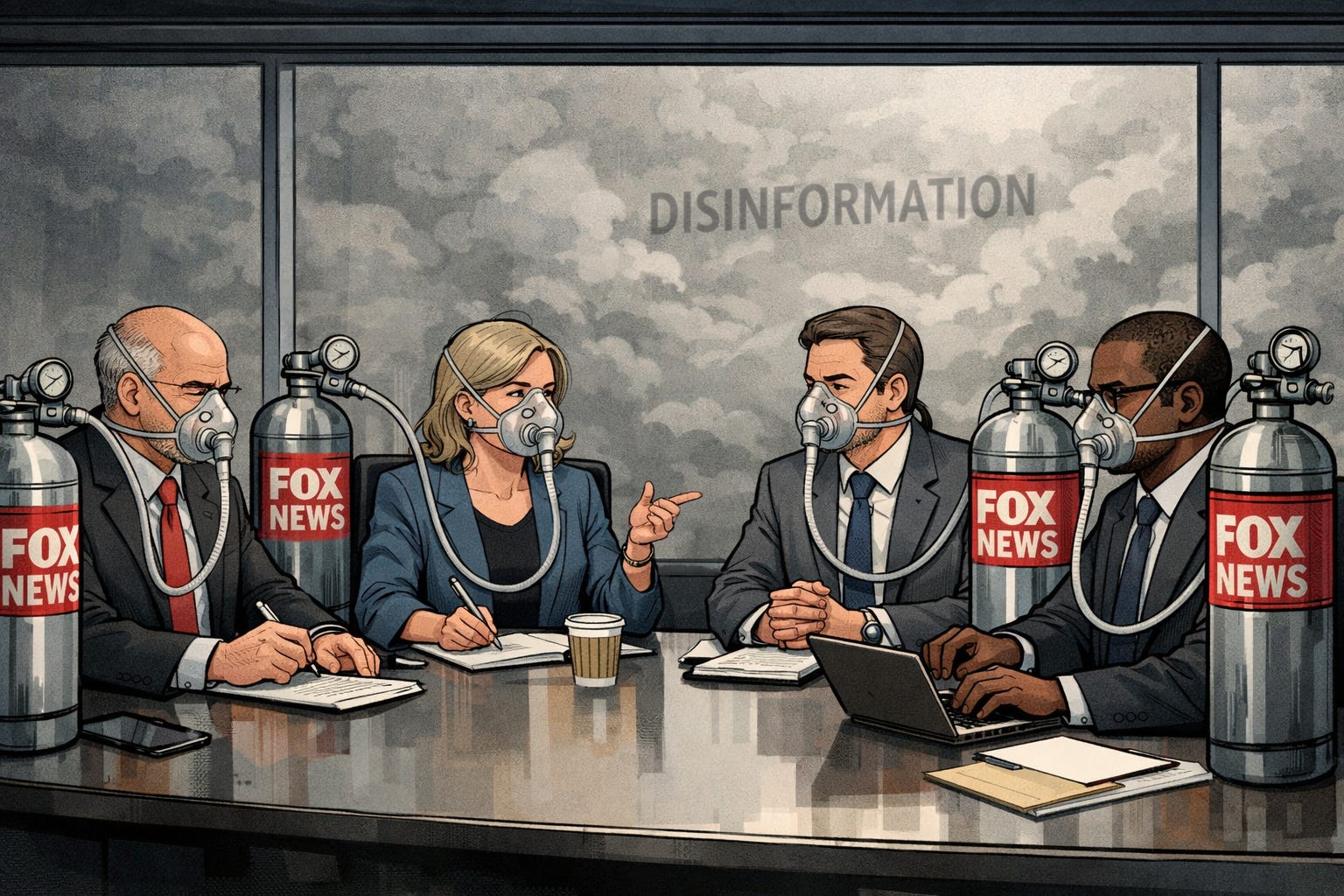
This is how Fox News narratives became the ambient air of political strategy.
Note: We’re 38 paid subscribers away from reaching 100. If these daily deep dives and historically minded reflections resonate, then consider joining as a paid subscriber. Support like yours keeps this engine running and for it to stay curious, critical, and prepared for the years ahead.
