
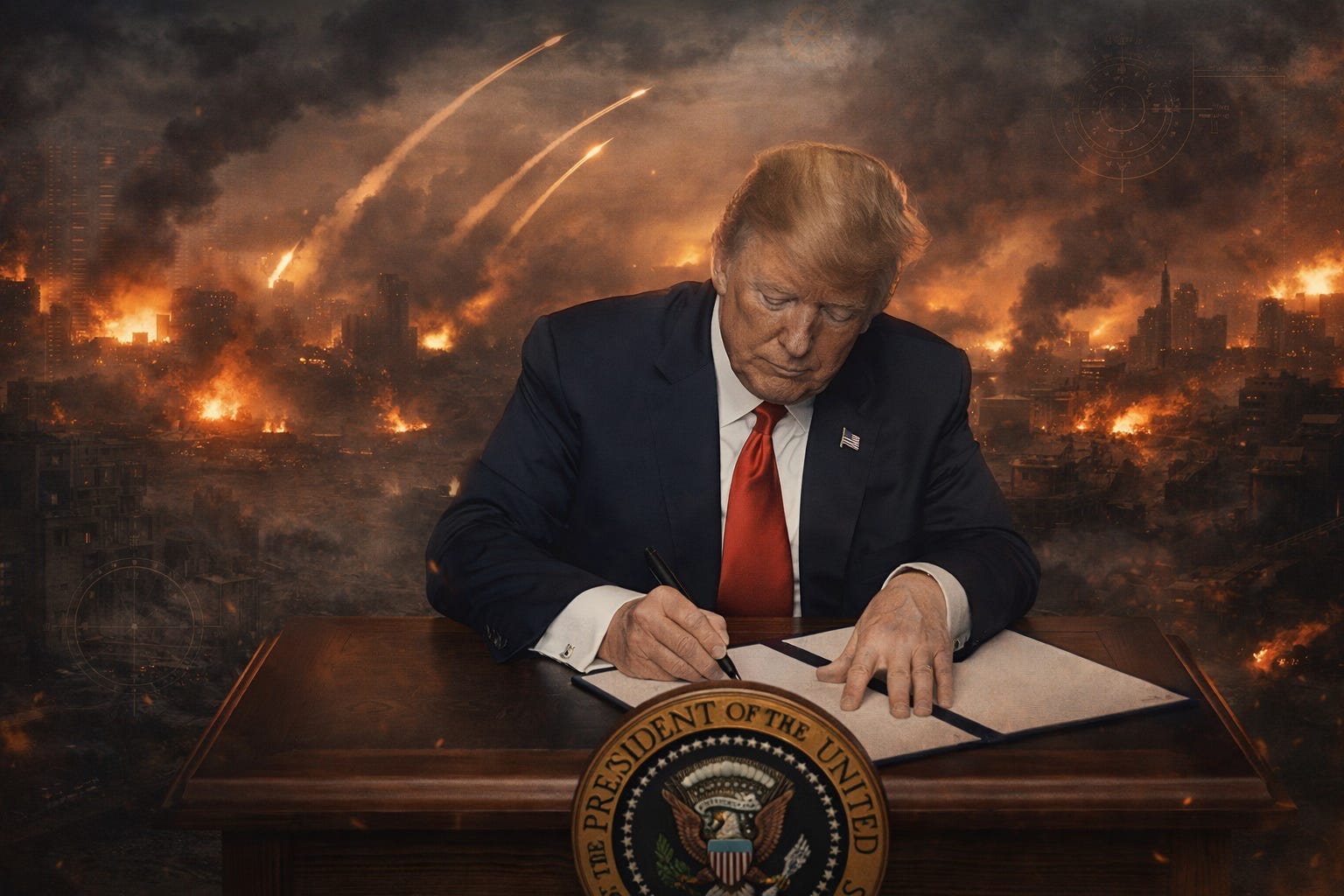
Trump’s First Term Controlled the Narrative. His Second Commands the Machine.
From Chaos to Command: Trump’s Darker Second Term

I’ve been thinking about this more intense sequel we are living through.
I’ve written before that sequels are good when they reveal the systems behind the central conflict. The first Trump term was often experienced as spectacle: cable news chaos, social media trolling, narrative domination, and the constant ability of one man to suck up all the oxygen in American political life. Trump’s return feels like a sequel in the truest sense because it is revealing more of the machinery behind that spectacle. The first term showed the excesses of the modern presidency as an agenda-setting force. The second is showing the excesses of the presidency as an instrument of command.
That shift matters more than a lot of the old commentary seems prepared to admit. Much of the reactionary centrist commentariat is still trying to interpret Trumpism through frames inherited from an earlier political era, as if the problem remains one of tone, norms, or messaging discipline. But those frames were already breaking down in the first term, and in some ways helped produce the conditions for Trumpism in the first place. What this sequel is exposing is not just the exhaustion of those frames, but the deeper institutional reality beneath them.
That reality is the presidency itself.
We have been living through an era in which the executive branch has grown across generations, if not across the entirety of American constitutional history. You can see it in Andrew Jackson’s executive populism and defiance, from Native American treaty violations to the nullification crisis. You can see it in Abraham Lincoln’s expansion of emergency power, which established enduring precedents for presidential coercion of private industry and civil liberties under the pressures of total war. You can see it in Theodore Roosevelt and Franklin Roosevelt, who expanded the executive’s agenda-setting power through force of personality and modern mass communication. FDR, of course, fundamentally transformed the relationship between the federal government and its citizens during the emergency of the Depression, creating New Deal institutions whose shadow still hangs over American politics today.
Then came the post-World War II fiscal-military state, which gave the presidency immense power over a sprawling national security apparatus, from advanced weaponry to intelligence gathering to surveillance. The office accumulated not only the power to shape public attention, but the power to direct vast systems of enforcement at home and abroad.
That is what makes this sequel darker.
Trump is not just returning as a master of media spectacle. He is returning to a presidency already swollen with command capacity. If the first term was defined by the excesses of the presidency’s ability to dominate attention, create a cultish political identity, and control the narrative despite overwhelming evidence to the contrary, then the second term may be defined by the excesses of the presidency’s tangible ability to project raw power across institutions and across the globe.
That does not mean those powers were absent from the first term. Family separation is an obvious example. That was an abuse of power in which the president used the logic of emergency to alter lives through direct state coercion. But the center of gravity now appears different. What once felt like a presidency organized around spectacle increasingly looks like a presidency organized around command and control.
That is true domestically, where the executive can discipline bureaucracies, direct agencies, and turn administrative power into ideological enforcement. It is true abroad, where the presidency sits atop the largest national security apparatus and international surveillance system known to mankind. And it is especially true in a political culture that has spent decades normalizing permanent emergency, permanent war footing, and the idea that presidents should act first while everyone else argues later.
This is part of why the current Middle East escalation matters so much. It is not only another possible quagmire. It is another reminder that the modern presidency contains immense stores of coercive power that many Americans will tolerate, and sometimes cheer, so long as they are wrapped in the language of strength. Given Iran’s role as a designated villain in the American political imagination for nearly half a century, Trump may once again be finding that saying and doing the quiet part out loud brings fewer conventional consequences than political professionals like to imagine.
Even if that argument sounds too cynical, it is probably less superficial than the consultant-class assumption that public opinion automatically restrains presidential militarism. The deeper story is that many Americans have been trained for decades to accept expansive executive action when it is coded as security, toughness, or national resolve. Trump did not invent that reflex. He is exploiting it more openly.
Which is why I think the real lesson of this sequel is not simply that Trump has become more aggressive. It is that the presidency itself has become more exposed. Trump is not inventing these powers so much as displaying and normalizing powers the office has already accumulated. The first term revealed the excesses of the rhetorical presidency. The second is revealing the excesses of the command presidency.
That is what makes this version more intense. The first term was about dominating the room. The second is about commanding the machine.


The evidence is that Trump has lost his mind. He believes that he is the king of the world, that he will be able to choose the next ruler of Iran. he is demanding that the president of Israel pardon Netanyahu or else.
He has started a war that will end badly. Iran is not Iraq, and has mastered missile and drone production and has produced so many that they have been able to supply them to HAMAS and sell them to Russia.
It will be a miracle if he hasn't started WWIII, he has already kicked the hornets nest, now all of the Arab states are involved, as is France,Greece, Turkey and India.
The DOD is sending missiles and bombs to destroy radar. communications and police facilities in Kurdistan Iran, and the CIAis arming the Kurds, Hegseth plans on sending special operators into Iranian Kurdistant.
This will alarm the Turks who have been fighting the Kurds (PKK) since WWII if not sooner, Iraq under Saddam gassed them.
The Kurds are Sunni Islam, and the Iranians are Shia Islam.And Iraq has its own volunteer militia, the Popular Mobilzation Force of Quwwāt al-Ḥashd ash-Shaʿbī
Iraq is 80% Islam,and the Quwwāt al-Ḥashd ash-Shaʿbī realize that they are Shia, and set aside the Arab vs Persian (Aryan, which is what Iran named itself) hostility, then it really could get ugly
Given that Iraq is majority Shia, as is Iran, Saddam played on the ethnic antipathy of Arab vs Aryan or Persian. to rally Iranians to his cause.
The name "Iran" derives from the Middle Persian word Ērān and the Old Iranian term *Aryānām, meaning "land of the Aryans". Rooted in the Indo-Iranian arya (meaning noble or free person), it has been used internally for centuries to denote the land of the Iranian people, officially replacing "Persia" in international use in 1935.
However even though, at the outset,Iraq was better armed (by America) could not defeat Iran, because Iran has a population of young males willing to be martyred, they even used young boys as living mine detectors on the trenches.
Iran has closed the strait of Hormuz, one ship carrying Iranian oil, was allowed through, the price oil has gone from $32 a barrel to over $87, which is a windfall for Russia.
Iranian drones have attacked and disabled three Amazon data centers, these were not used for their retail ops, but were part of the European and American military and intelligence centers.