

For three decades, the American-led order functioned under the assumption that the Cold War’s end signified the end of ideological competition. Liberal democracy would spread, markets would integrate everyone into good behavior, and wars would be quaint anachronisms like smoking in public places.
This assumption wasn’t just false. It was a convenient lie. It allowed policymakers of all stripes, both neoliberals and neoconservatives, to assume American power as the background music of world politics. Something that was always playing, never discussed, and paid for by someone else’s short attention span.
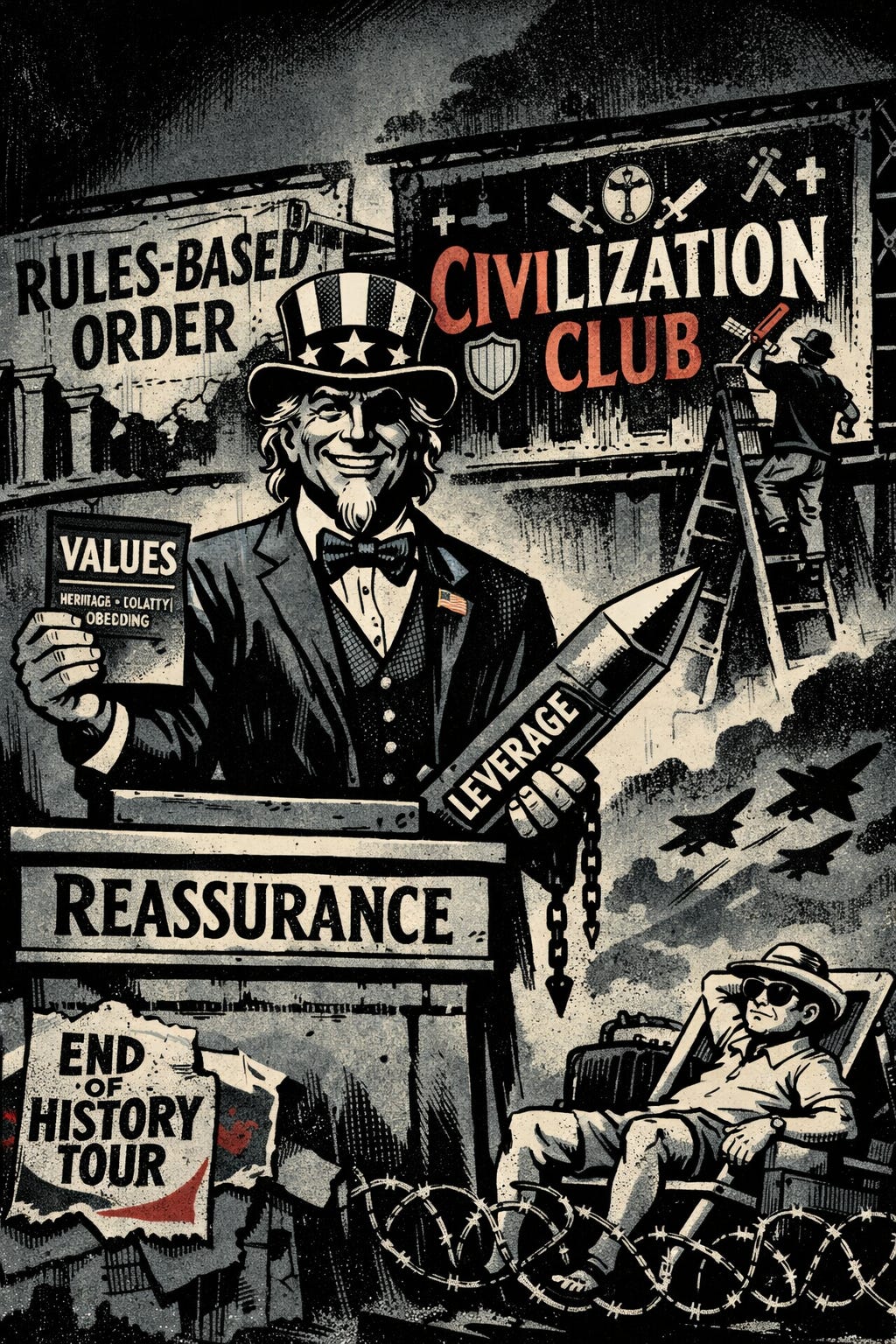
Secretary of State Marco Rubio’s recent message to Europe illustrates this nicely. The fantasy of the “end of history” was an oversight. The world has changed. Liberal democracy isn’t the inevitable endpoint of human history. Power politics never went away.
So far, so true.
But then there’s the part where the “reassurance” reveals its true face. According to Nathalie Tocci’s argument, Rubio’s softer tone isn’t a return to the old liberal internationalism of the previous administration. It’s just the same suit, tailored better. J.D. Vance may have given the circus act, loud, crude, and intended to shock. Rubio’s presentation is softer, more familiar, and more statesmanlike. The similarity between the two? They both shift the meaning of “the West” from a political ideal to a civilization.
This distinction matters for American soft power.
Soft power, however, has not disappeared. Soft power has mutated.
The old American pitch, at least the one we sold, even when we betrayed it, was universal. The West was selling constitutionalism, rights, institutions, pluralism, and the notion that legitimacy was derived by consent, not bloodline. This was always an imperfect story, often hypocritical, sometimes violently contradictory.
But it was still a story that could recruit allies, build coalitions. It was still a story that allowed Washington to say, “Join us, because we’re for all, everywhere.”
The new pitch is different. It’s no longer, “We represent universal rules.”
It’s, “We represent civilization.”
Heritage. Tradition. Religion. Cultural lineage. Kinship.
This is still soft power, just not liberal soft power. This is still attraction, identification, just not with the rest of the world. This is the kind of soft power that does not expand by attracting new adherents. This is the kind of soft power that consolidates by disciplining its own.
In this world, values are about cultural boundaries and not about rights. The goal isn’t to recruit new members to the rules-based order. The goal is to mobilize our side against the other, to mobilize our side against internal enemies, while keeping the machinery of power firmly in American hands.
The old world was “Rules, plus Leadership.”
The new world is increasingly “Identity, plus Hierarchy.”
Why Europe hears reassurance, and Tocci hears empire.
Many Europeans heard Rubio as a soothing antidote to the administration’s harder edge: a familiar tone of voice after months of purely transactional diplomacy. But the danger is precisely what Tocci warns of: a tone that reduces the alarm level, while the content continues to signal a degradation of European autonomy.
NATO and partnership can continue, but in a much less equal relationship. Not “We have a shared project,” but “We have a shared bloc, and that bloc has a boss.”
Let me illustrate what I mean with some examples:
Security guarantees become conditional, not shared, not based on shared principles or shared rules, but on services rendered in return for compliance. Europe is urged not to rearm to become strategically independent, but to become strategically useful within a strategy defined by America.
European internal politics is on the bargaining table. If “the West” is a cultural club, then who are the “true Europeans,” or the real defenders of civilization, is now a political weapon.
This is where the “civilization” talk ceases to be mere rhetoric and becomes a means of coercion. It is a means of saying, “We are family, therefore we have a claim to loyalty,” and, “If you don’t agree with me, then you are not merely mistaken, you are a traitor to our family story.”

The unresolved history behind it.
And that is why, I think, this moment feels like a reckoning with unresolved history in both America and Europe. Global liberalism did not die because it was not moral enough; it died because it was moralistic in rhetoric, coercive in reality, and because America and Europe have not, in fact, come to terms with their own histories, with their own unresolved contradictions.
In the United States, those contradictions include the obvious: race, citizenship, violence, inequality, ideals vs. reality. And when those are only half-addressed, they become fuel rather than dissipate. Fuel for a revanchist politics that doesn’t see liberal universalism as an ideal, but as a con. The pitch now is: The “rules-based order” has been a lie we’ve told to weaken ourselves, flood our societies, erase our heritage, and become soft.