

Today, I am making available without a paywall a piece I wrote earlier this year called “The Fragmentation of Black America.” It explores the changing world within Black America and the nation at large, interrogating how we talk about racism, how we conduct internal communal conversations, and how we grapple with the legacies of post-colonial trauma. In light of recent debates, it feels even more timely.

Earlier this week, Xavier Plisset (of Xplisset) responded to a video I made about Representative Jasmine Crockett’s Senate announcement. In that video, I made two key points: First, that centrist Democrats (not necessarily moderates) seemed to immediately pour cold water on Crockett’s candidacy, draining energy from the most activated corners of the electorate. And second, I explained why I foregrounded her identity as a Black woman, especially in the context of a campaign ad where the sitting President belittled her intelligence and she responded with poise, even as the symbolism of his remark loomed large.
Xavier’s response was layered and heartfelt. He challenged my framing of centrists, offering instead a reading rooted in trauma: the reflexive fear born of decades of Democratic losses in Texas. The centrist instinct to temper enthusiasm, he argues, is not always about sabotage. It can also be about the pain of false hope. In Crockett, an outspoken Black woman who has made some rhetorical missteps, many see both a fighter and a liability. The deeper question becomes: can we hold both realities at once?
His second point hits even harder: that the internal conversations Black America needs to have about rhetoric, accountability, strategy, and harm are becoming harder to conduct in public without being weaponized by outsiders. Whether it’s White conservatives dismissing systemic racism or White liberals using intra-Black critiques to sideline radical voices, the result is the same: the erosion of safe space for necessary reckoning.
This gets to the heart of a question I’ve been circling for some time: Can a fragmented community, shaped by uneven access to power, class mobility, and proximity to Whiteness, still have the kinds of vulnerable, transformative conversations it needs, especially in view of a public conditioned to misunderstand us?
Xavier’s reflection reminded me of the work of William Julius Wilson, whose landmark book “The Declining Significance of Race” caused waves when it first argued that economic class had become a more decisive factor than race in shaping Black life outcomes. Critics, especially those in racial justice spaces, worried that this framing might undermine the case for anti-racist policy. But Wilson never argued that racism had disappeared. Instead, he highlighted a more complex truth: that as some Black Americans ascended into the middle and upper classes, others were left behind, deepening intra-community divides.
Later in his career, Wilson would clarify and revisit his arguments, explicitly warning against those who used his work to justify colorblind or race-neutral policy approaches. He affirmed that both race-specific and class-based remedies were essential. In other words, the fragmentation was real, but so too was the need for nuance in how we understood and addressed it.
This is where I think both Xavier and I converge. When he writes about the nervous centrist who flinches at Crockett’s unapologetic tone, and the base voter exhausted by the demand for “safe” candidates, he’s naming the same fragmentation I’ve been writing about. One that class, geography, gender, and access to Whiteness have all deepened.
To respond directly to the central tension in Xavier’s critique, the worry that the new moral center is becoming a generational identity position, incapable of pluralism, I’d offer this: Pluralism only thrives when there’s a shared moral floor. If political dissent is grounded in data, shared humanity, and historical context, then disagreement is productive. But when dissent is built on bad data, essentialist framings, or appeals to learned prejudice, we can’t assume good faith by default. The tragedy is that America has never built that shared floor across lines of race, and so we now inherit a space where epistemic and moral gatekeeping are in constant, often uncomfortable dialogue.
To me, the fact that Xavier chose to name me and respond in public is not a rupture, but a gift. It means the conversation is still alive. It means that, in the fractured house that is Black America, someone is still knocking on the other side of the wall.
America’s healing is inseparable from Black healing. And Black healing requires room to speak our truths, not always cleanly, not always in harmony, but with the expectation of grace, context, and growth. Jasmine Crockett is stepping into a political moment that asks her to be fierce, flawless, and forgivable all at once. That double bind is not hers alone. It belongs to all of us.
Much love.

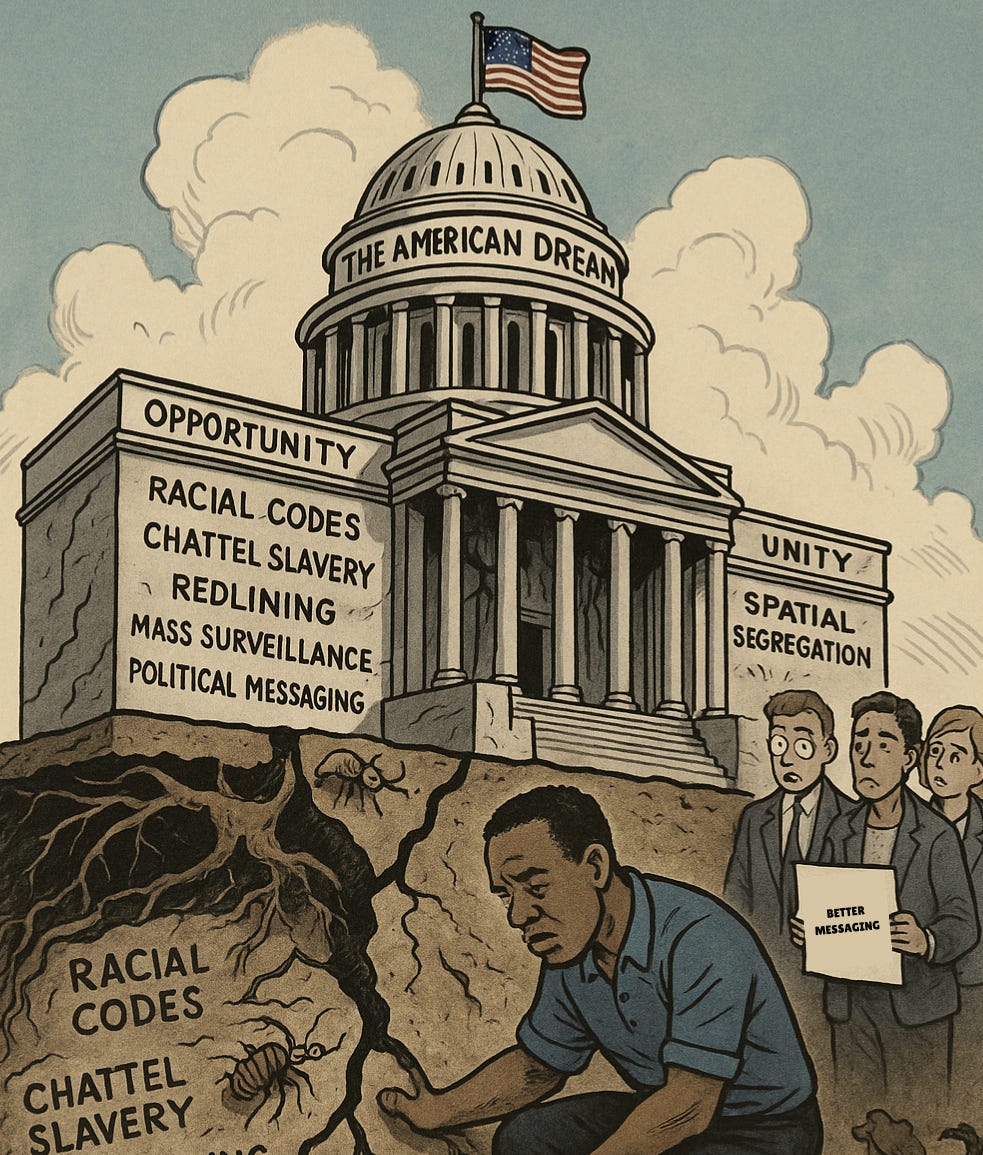
It should be clear by now that one of the central reasons for America’s current unraveling is its refusal to reckon with the foundational role race has played in shaping its institutions, policies, and national psyche. Instead of confronting that reality, we’ve built layers of policy, planning, and cultural narrative on top of a foundation still rotting from the termites of racial hierarchy and historical denial.
That refusal isn’t just morally corrosive. It can be destabilizing. The failure to fully grapple with the legacy of slavery, segregation, and structural exclusion has left us vulnerable to precisely the kind of democratic backsliding and reactionary backlash we’re living through now. And yet, many in a desperately needed recalibrated political center, particularly among establishment Democrats and adjacent pundit classes, remain committed to framing our crisis as a problem of “messaging,” or voter outreach, or civility, rather than one of deeper structural rot.
It’s a seductive narrative, this idea that America is exceptional, that we are perpetually progressing, that with just a bit more moderation, we can “fix” things. But it only holds if you’re willing to ignore the experiences of those who’ve lived in the margins: immigrants from war-torn nations in the Global South, Indigenous people forcibly displaced from their land, Black Americans whose attempts at generational stability have been systematically sabotaged for centuries.