



The price of oil is more than a market signal. It is a measure of the health of a global system built around extraction, transportation, and control, and it carries profound consequences for nations like Venezuela, whose political economy exists in the fragile posture of a petro-state. Venezuela’s fortunes have long been tethered to oil revenues derived from external markets, a dependency that promises wealth while reliably delivering instability, distortion, and vulnerability.
As the American holiday lull ended, the United States disrupted Venezuelan state life by capturing its head of state, Nicolás Maduro, and transporting him to New York to face trial. Images circulated of a fallen strongman blindfolded and dressed down while U.S. officials made clear that Venezuela’s remaining leadership now operates under a stark new reality. The message was not subtle: cooperate with the new order taking shape, or risk sharing the same fate. Whatever legal justifications are articulated, this was a demonstration of power meant to be seen.
This is another mask-off moment for the United States. Yet even now, familiar Bush-era voices rush to draw distinctions by arguing that this administration did not even bother with the theatrical language of democracy or humanitarianism before engaging in regime disruption. That difference may matter in academic or rhetorical terms, in parsing when empire performs and when it dispenses with performance altogether. But it does not restore a clean moral line between Trump and some imagined noble era before him. What it reveals instead is continuity: a long-standing imperial logic, now spoken plainly. Trumpism excels not because it invented this logic, but because it is unembarrassed by it.
Margarita López Maya’s analysis of “rentier socialism” helps explain why Venezuela arrived at this point so exposed. Writing in the aftermath of Hugo Chávez’s death, López Maya described a system that never transcended the rentier oil model that has shaped Venezuela since the 1920s. Under Chávez and later Maduro, the state oil company was transformed into a multifunctional political instrument tasked not only with extraction and export, but also with financing social missions, distributing food, constructing housing, and underwriting political loyalty. This arrangement hollowed out productive capacity, encouraged corruption, and degraded managerial expertise. The result was not sovereignty strengthened by socialism, but a brittle petro-state increasingly detached from its own society and dependent on continual oil rents to sustain political authority. A state organized this way does not simply stagnate. It becomes legible to external powers as an asset to be stabilized, managed, or reclaimed.
That vulnerability collides directly with the historical reality David Painter lays out in Oil and the American Century. The painter reminds us that American power did not merely rely on oil; it was built around it. Oil fueled the war machines of the First and Second World Wars, underwrote twentieth-century consumer abundance, and repeatedly shaped U.S. foreign policy decisions toward both adversaries and uneasy allies. Embargoes, price shocks, and energy crises were not aberrations but structural features of a world in which oil determined the limits of power. In this context, Venezuela has never been simply a sovereign nation; it has long been understood within Washington as a strategic energy zone whose internal politics matter insofar as they affect access, stability, and control.
There is genuine hope, in Venezuela and beyond, that this weekend’s events do not spiral into mass instability or regional contagion. But it is difficult to ignore that another quiet part has now been said out loud. The Trump administration has once again done what it does best: stripping away the comforting narratives Americans tell themselves about innocence, legality, and benevolent intent, and exposing the more complex truth about how power has actually operated. The discomfort this produces, especially among institutional voices invested in the myth of a nobler past, is understandable.
But clinging to that myth prevents a more necessary reckoning: not with Trump alone, but with America’s long-standing role in the world, whether we find that role reassuring or deeply unsettling.
References:
Maya, Margarita López. “Venezuela: The Political Crisis of Post-Chavismo.” Social Justice 40, no. 4 (134) (2013): 68–87. http://www.jstor.org/stable/24361611.
Painter, David S. “Oil and the American Century.” The Journal of American History 99, no. 1 (2012): 24–39. http://www.jstor.org/stable/41510299.

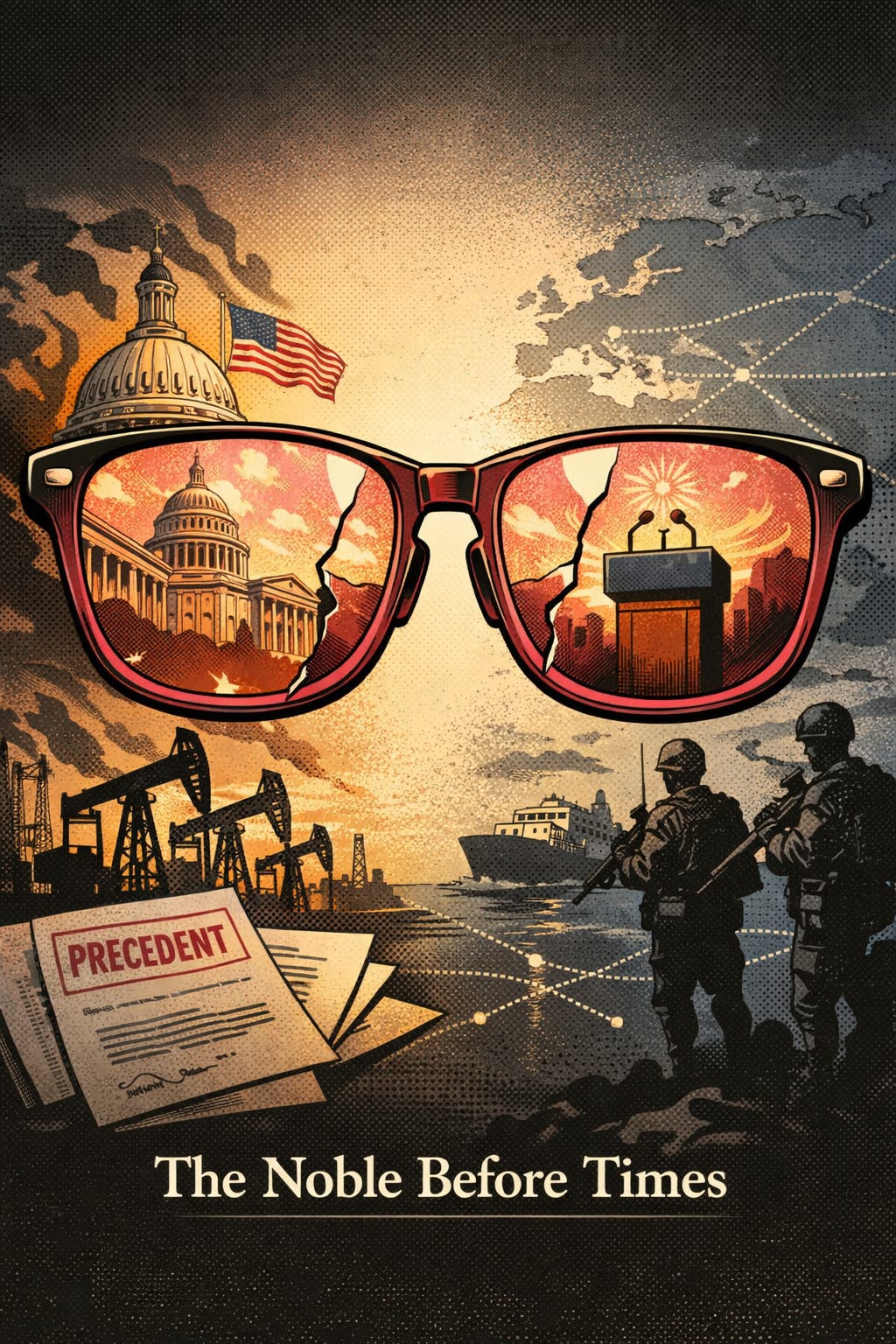
The Myth of the Noble Before Times
This should be the moment when we finally stop indulging the institutional voices of the pro-democracy coalition, which insist that our task is to carefully distinguish between good conservatism and bad conservatism. That distinction has become a political shelter rather than an analytical tool. The permissions currently being extended to the Trump administration are not novel departures. They are familiar precedents intensified. What we are witnessing looks less like a rupture than the Brooks Brothers riot scaled up to state power, or the ambitions of the Project for a New American Century executed without the language of benevolence.
Trump is not a break from a nobler institutional past. He is a continuation that is more explicit, less embarrassed, and more efficient. That reality forces an uncomfortable question as we enter 2026: Does the pro- and anti-Trump framing now primarily serve neoconservatives and neoliberals who need Trump to be uniquely aberrant to preserve the fiction that what came before was fundamentally sound? Because once Trump is understood as revelation rather than deviation, the moral insulation of the pre-Trump order collapses.
A paid subscription gets you:
Full access to the archives
The ability to comment and join the conversation
Stew’d Over, and other bonus daily newsletters!
Live Ask Me Anything sessions with paid readers — coming 2026!
This independent work is sustained by readers who want more than headlines and hot takes. Offer ends on January 6th.
