

The Protest Was Real And So Was the Misdiagnosis
A decade of denial doesn’t get fixed by a single day of protest.

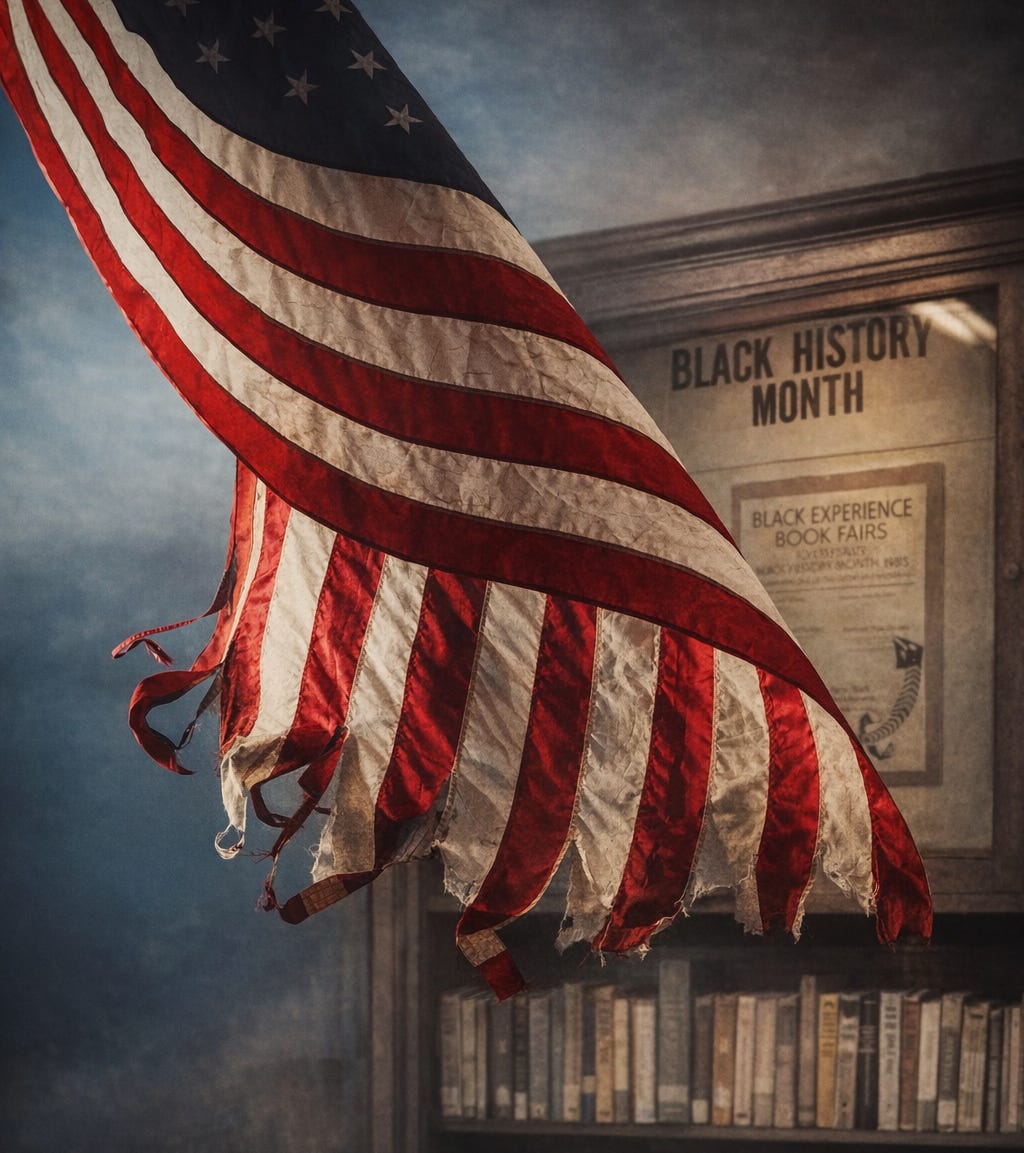
No Kings was a good development. I don’t want anyone to think I believe otherwise. In an article I published on Saturday, I may not have made it clear enough that I am with many other Americans in asking a simple question: Now what?
I decided to go to the Orioles game to reconnect with friends I hadn’t seen in a while, people and relationships I had neglected during the first Trump term. Back then, I believed that following every development and committing my time to the cause would be part of something larger.
Instead, it often meant being told that Trumpism was unique (an aberration) and that calling attention to post–Civil Rights racial realities was too divisive. The problem, more often than not, was not the inequity itself. It was the discomfort that came from naming it plainly. I connected with people in the corporate media world through my graduate program and online interactions. But there was a consistent impulse to treat Trump and those shaped by the disappointments of the Obama years and the racial truths exposed during the Trump years as a one-off deviation from an otherwise serious political order.
That meant my candor about what Trump was tapping into wasn’t received well. The lesson, implicit and sometimes explicit, was clear: talk about Trump’s tone, not the conditions that made him possible.
Corporate commentary often did not say Trumpism was innocent of racism. It did something more useful for the establishment, which is to treat racism as downstream of progressive provocation. In that telling, the right was not advancing a self-generated political project so much as reacting to liberal excess. Müller names this directly when he argues that one of reactionary centrism’s “iron laws” is that only liberals have agency, while the right “just reacts.”
That instinct didn’t stay in private conversations. It became a media framework. The focus stays on the man, not the machine, and that distinction matters more than we’ve been willing to admit. It is also the reason Trump was able to mount a comeback despite all of his indiscretions. Media framing did not name the moral stakes in a manner that alarmed enough people and continued to draw false equivalences.
This was my reality from 2018 to 2022, and it has been an exhausting journey. It’s also why I’ve found intellectual grounding in a growing body of work asking whether centrism, especially reactionary centrism, is helping or harming the pro-democracy effort.
What some scholars call “reactionary centrism” isn’t abstract. As Jan-Werner Müller argues, it presents itself as even-handed while directing its sharpest criticism toward the left. The result is a false equivalence in an already asymmetrical political environment.
That dynamic is not theoretical to me. I lived it. Naming racism clearly was treated as an excess. Meanwhile, the conditions that made Trumpism possible were softened, reframed, or ignored.
More plainly, there has been more energy spent litigating “wokeness” and preserving the idea of a noble conservatism than reckoning with how that same ecosystem helped midwife Trumpism.
A particular instinct emerges in moments like this, presenting itself as reasoned, sober, even necessary. It acknowledges that something has gone wrong, that the political environment has shifted, that Trumpism represents a real danger. But then it performs a quiet translation. The problem is not treated as a self-directed radicalization of the right, but as a failure of Democrats to remain within the bounds of what voters find acceptable.
You can see this clearly in arguments like Matthew Yglesias’s, where Democrats are said to suffer from a “toxic brand” that must be repaired not just rhetorically, but substantively by reconsidering positions on race-conscious policy, immigration, gender identity, and other issues tied to the party’s public image. On its face, this reads as pragmatic. But the asymmetry is hard to ignore. The right is allowed to radicalize, to reshape institutions, to push the boundaries of democratic norms. The left, meanwhile, is asked to adjust, discipline itself, moderate, and become more acceptable within the environment that the right has helped create.
That is the core of what makes this reactionary centrism. It does not deny the danger. It relocates the response. It treats the right as reactive and the left as responsible, placing the burden of correction on those already being asked to absorb the consequences of the current political order.
It shows up in the quiet rehabilitation of figures tied to the Iraq War, deregulation, and decades of culture war politics. Once Trump crossed a line they could no longer ignore, they were recast as guardians of democracy. The past was softened, the record blurred, and the movement lost the ability to fully account for how we got here.
Yet those same reactionary centrists continue to shape the pro-democracy conversation as long as it avoids naming the intellectual blind spots and political opportunism that led to this moment.
That is why I can still be proud of the No Kings protest and far more interested in what comes next, whether that is the May 1st call for a national strike or other forms of sustained, structural engagement. Because the question is not whether protest matters. It does.
The question is whether it is enough.
Recent analysis suggests that long-standing faith in moderation and symbolic politics is breaking down. Authoritarian movements require sustained, structural responses rather than episodic displays of dissent. Visibility is not the same as leverage. And we have spent too long pretending that it is.
That gap between visibility and leverage is not just theoretical. It is something others have begun to name more directly. As Stacey Patton argues in her critique of the No Kings protests, what we are often witnessing is not disruption, but ritual, something that “lets America feel brave without doing anything.”
She describes a cycle that feels too milqtoast and familiar as people gather, chant, and leave with the emotional residue of having participated in something meaningful, even as the underlying structures remain unchanged. The protest becomes a pressure valve rather than a pressure point, something that releases tension without fundamentally threatening power.
And when that cycle is questioned, the response is just as revealing. As she notes elsewhere, the reaction is often not reflection but defensiveness, demands for answers, for plans, for reassurance, often directed at the very people who have been naming these structural realities the longest.
That is the space I find myself in. Not dismissing the protest. Not denying its emotional or symbolic value. But asking whether we are confusing participation with power, presence with pressure, and ritual with transformation.
Once there is a real effort to address the structures that led to this in both parties and within the media ecosystem, then we can begin to have an honest conversation about what this moment demands.
That includes institutions like CNN, The New York Times, The Bulwark, The Free Press, and The Dispatch, spaces that too often balance critique of the right with discipline of the left.
Until then, the pattern will hold. Punch at “wokeness,” litigate a noble conservative past that never really existed, support protests while tone-policing their implications, and elevate strategies that avoid deeper structural critique.
And then wonder why nothing changes.
So when I ask “Now what?” it is not from detachment.
Instead, it is from recognition.
This is the disaffection I carry as a Black man who understands that this has been unfolding for ten years (and longer) and that the deepest costs were borne by those on the margins. That is why the decline persists. The fantasy is easier to maintain than the truth is to confront.
We have built a politics that mistakes comfort for clarity. Where pain on the margins is treated not as a warning, but as rhetorical excess.
And so the fantasy survives not because it is true, but because too many are still willing to look away.

I read your article this afternoon, and I’m very intrigued by the concept of “reactionary centrism, which I’ve never heard identified in that way.”
Yesterday I published a Substack post entitled “After the March, What Now” because I know many people who are willing to march, which is great, and then just wait for the next March. I do not believe that’s enough to get us where we need to go. We just need to go much further.
Thanks for sharing your thoughts. I appreciate your sentiments on this, and like you, I’m very happy that the March happened. We just need to go much further. Thanks for sharing your thoughts.
https://anitanelam.substack.com/p/after-the-march-now-what?r=1obidc&utm_medium=ios
We need a REDEEMED GOVERNMENT, to lead the people INTO redemptive action. However, I also believe it was CORRUPT PEOPLE ELECTING CORRUPT OFFICIALS. It seems like a paradox, but it is not. It is the rational outcome, from an irrational MINORITY which has the MAJORITY of power (the extra wealthy, and the EPSTEIN class).
This has been progressing for years and years. There has been an absolute "hornet up the ass" of the FBI, and the federal government since Martin Luther King Jr., and Malcom X. But, the problem continues: the rich get richer, and the marginalized get "DEPORTED". NOW, that is what I see happening!!!
Have a nice day,! 😁