
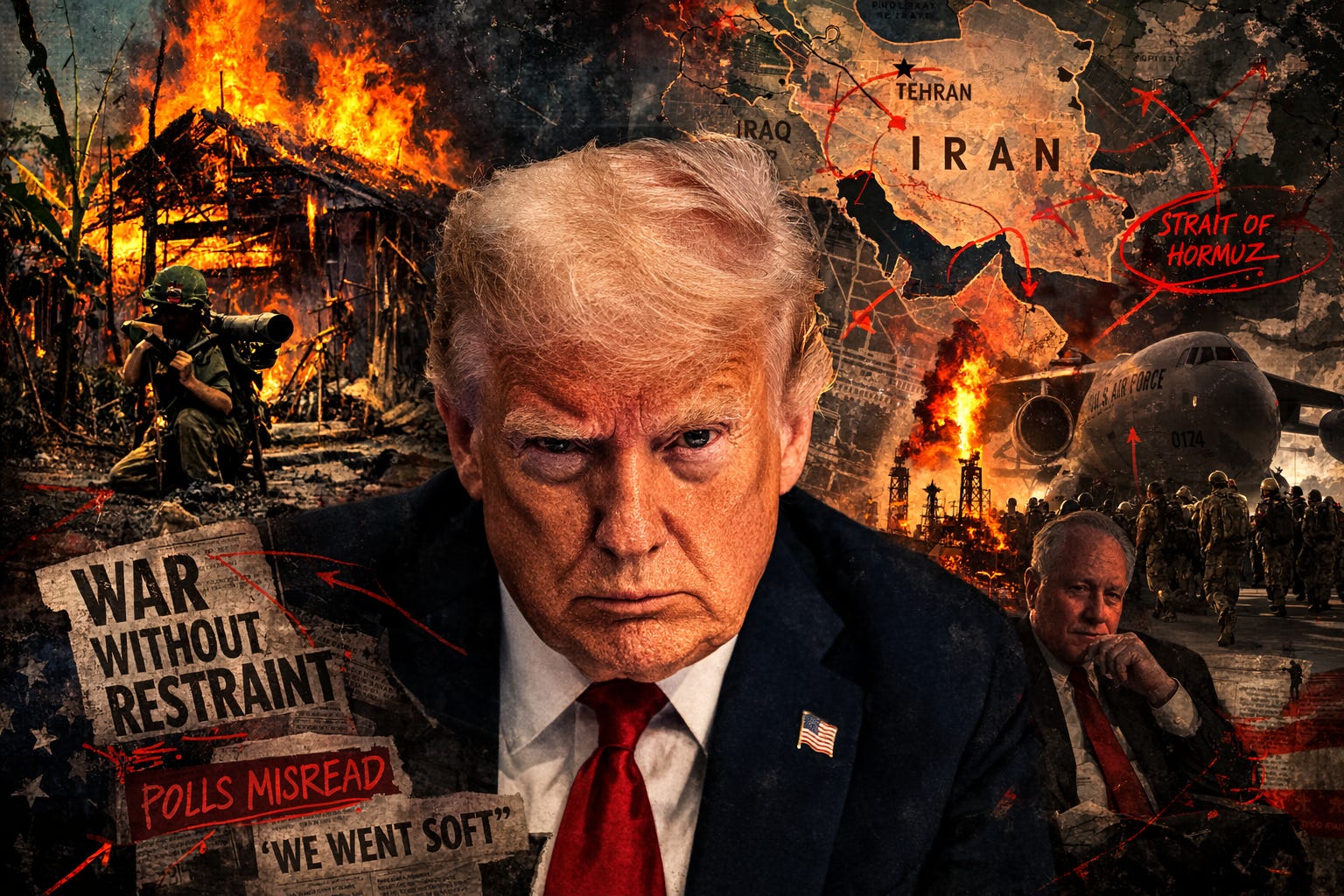
The Old Fire Behind Trump
Why treating the Iran war as automatic political damage misunderstands the deeper American appetite for force.
Author’s Note: I have been on a tremendous journey, one that has brought me into the brotherhood of Kappa Alpha Psi Fraternity, Incorporated. It has been a beautiful period of self-discovery, history, legacy, and reverence. With this chapter of the journey now complete, I am ready to return to the daily rhythm of this newsletter.
Something I have noticed in much of the commentary around the Iran war is the reflexive assumption that this must represent a down period for the Trump administration because focus groups somewhere report anti-war instincts or because polling suggests hesitation about escalation. That reading may feel intuitive, but American political history is littered with moments where military anxiety did not produce restraint so much as a demand that force be used more decisively, more brutally, or with fewer inhibitions.
There has long been a powerful strain of American thought that interprets military frustration not as evidence of darkness at the heart of empire, but as proof that empire has failed to go far enough. Bill Kristol offered one clear example in 2004, when the glow of “mission accomplished” had faded and the Iraqi insurgency was becoming impossible to ignore. Rather than questioning the invasion itself, he argued in Too Few Troops that the United States had committed too little force to secure victory. Two years later, Norman Podhoretz attacked what he saw as mounting retreat from the Iraq war effort, insisting in The Panic Over Iraq that the greater danger was not strategic folly but elite loss of nerve.
That pattern reaches further back. During the Vietnam War, major right-wing voices repeatedly blamed defeat not on the destruction visited upon Vietnam, the impossibility of the military objective, or the moral corrosion of the campaign, but on domestic hesitation. Barry Goldwater argued that restrictive rules of engagement had cost America victory. Spiro Agnew turned media criticism itself into a political villain, helping establish the enduring right-wing mythology that wars are lost because reporters, protestors, and liberals sap national will. The battlefield became secondary to a cultural narrative for many: that America did not lose because the war failed. America lost because America became too soft to finish what it started.
That instinct has never fully disappeared. In one era, it is “liberal defeatism.” In another, it is “political correctness.” In another, it is the claim that lawyers, diplomats, and human rights language tie the hands of the military. Beneath all of it sits the belief that force fails because restraint intrudes.
That is why it is striking to scan recent The Bulwark commentary and see such confidence that the Iran war must function as an anchor on Trump. Some of that analysis seems driven by polling snapshots and by the perfectly understandable desire to see Trump weakened by events. But another possibility is that parts of American political culture still respond favorably to displays of hardness, especially when force is framed as preemption against an old enemy. The question is not whether Trump is reckless (he plainly is) but whether recklessness itself can still be narrated as strength.
Trump’s team appears to understand this well. They are already presenting military action not as a new adventure but as a delayed necessity: direct action against an existential threat rather than endless hesitation in the face of Iranian networks and long-festering hostility. If retaliation expands, if Americans die, if a terrorist incident is tied rhetorically to Iran, whether directly or indirectly, the administration has fertile ground for a delayed rally effect. Fear is old political fuel, and American memory around Iran has been layered for decades with hostage crises, proxy conflict, nuclear anxiety, and civilizational language about enemies who supposedly only understand force.
Polling, meanwhile, is far less stable than television panels pretend it is. Public opinion in 2026 moves quickly, often under the pressure of event framing rather than fixed conviction, and polling itself is now publicly distrusted in ways that make instant interpretations shakier than they once appeared. Trumpism has repeatedly survived moments that conventional political analysis treated as gravitationally impossible because it does not operate within the old grammar of performative nobility. It operates through performative power, sometimes theatrical, sometimes blunt, sometimes frighteningly effective, precisely because it does not care whether elite observers find it vulgar.
And war changes the presidency. The modern American president already possesses extraordinary agenda-setting power, but military confrontation further expands that atmosphere as executive discretion widens, dissent becomes easier to stigmatize, emergency language thickens the air, and institutional caution often arrives too late. What distinguishes Trump’s second version from the first is that he now appears far more willing to exploit the full emotional and constitutional theater of the office. Commentary that still assumes a fantasy America, one where scandal, contradiction, or polling discomfort automatically disciplines presidential force risks being outmaneuvered by a movement that understands how deeply American politics still responds to command, threat, and spectacle.


Another “hit the nail on the head” post. Anyone who feels that Trump is on his heels due to miscalculation has not been paying attention to American history. The second a passenger jet goes down due to Iran (or even suspected), the calculous flips. The irony of course is that we shot down an Iranian jetliner in the not so far past, and George Bush the Elder gave medals to the U.S. serviceman who shot it down. As Chris Hedges has brilliantly pointed out, we are a bloodthirsty nation who shapes our national self around armed conflict.
The intent of the not-a-war (special military operation is already trademarked) is to create exceptional conditions (as per Carl Schmitt) that will be the basis for the suspension of 2026 elections. Cuba comes next. For more on Carl Schmitt, search for 'Carl Schmitt 1934'