
The Myth of the Adult in the Room
Why responsibility not restraint is what democracy actually demands.

I have been suffering from a minor case of writer’s block. Not because there isn’t anything to say, there is too much to say. Politics hums like a broken machine, history repeats its darker refrains, and the news cycle demands we relive it all in real time. It is not silence that stalls the writer, but the exhaustion of witnessing the same story told with new names and familiar endings.
So instead of chasing the churn, I want to step away from it (just for a moment) and talk about something smaller that is, in truth, much larger: the responsibility of being a safe adult.
As a child, the world arrives unfinished. It is soft clay, shaped by example before instruction, by tone before doctrine. A child does not learn what a society believes by reading its laws; they learn it by watching how adults treat one another when they think no one is looking. That is where citizenship begins, not in the ballot box, but in the living room, the classroom, the quiet spaces where values are practiced long before they are preached.
And this is where things begin to unravel.
Because when adults fail in that role when cruelty is normalized, when disrespect is excused, when power is modeled as domination rather than care, that failure does not stay contained. It travels, it scales, and it becomes culture, then politics, then policy. What begins as a lesson at home can end as a justification for how a nation governs itself.
But too often, that posture is less about responsibility than preservation. Preservation of norms, of institutions, of a social order that feels stable to those who benefit from it. In that framing, imagination becomes a threat, and urgency becomes immaturity. And those who dare to demand something better are treated like children for refusing to make peace with a broken world.
That, perhaps, is one of the great evasions of our time. The people most eager to call themselves adults are often the ones most committed to keeping the furniture in place. They defend the room's arrangement and call it wisdom, or they confuse skepticism with depth, cynicism with realism, and managed decline with maturity. But there is nothing especially mature about protecting a status quo that produces humiliation, alienation, and democratic decay. There is nothing wise about sneering at hope simply because hope might require sacrifice.
Real adulthood is not tone-policing.
It is not standing in the middle of a burning room and congratulating yourself for having a calm voice.
It is not punching down at those who still possess enough moral clarity to imagine a better world.
Instead, real adulthood is taking responsibility for the world you help reproduce.
That is what being a safe adult means, too. It is not merely being kind in private. It is modeling what care looks like when things are uncertain, unfair, or breaking apart. It is showing the young (and perhaps reminding the old) that strength is not domination, that restraint is not the same thing as wisdom, and that responsibility sometimes requires disruption. Especially when the existing order has become a machine for flattening human possibility.
There is a reason that moments of democratic fragility often feel strangely immature, almost adolescent in their impulses. Entire societies begin to act like children who were never guided, lashing out, testing limits, and confusing strength with disregard. In those moments, what we are witnessing is not just political failure, but generational failure. A breakdown in the quiet, daily work of showing what it means to be responsible for one another.
And that is why being a safe adult matters more than we often admit. It is not soft work, and it is not apolitical. It is, in many ways, the most foundational political act there is. Because the values we model, patience, dignity, restraint, and empathy, are the only things that can outlast us. They are how we compete with time itself.
We cannot control the churn of history.
But we can control what we pass on within it.
And if democracy is to survive its darker cycles, it will not be because we found the perfect message or the cleverest strategy. It will be because enough people chose, in the smallest and most ordinary moments, to act like adults in a world that increasingly rewards the opposite.
I will be going live tonight to discuss Peter Wehner’s article in The Atlantic on conservatism and what Trumpism allegedly did to it, which is kill it. In my opinion, Trump specifically exposed an American style of conservatism due to our racial history and also the broader strain of conservatism that preserves hierarchy over values. But I will discuss more tonight!


Thanks for a thought-provoking essay springing from a perspective that ought to be the standard for raising children and interacting with others in society. I was fortunate to have parents who were active in politics as support for a party and candidates and treated every person as an individual, not a representative of a demographic group. I concluded Remaking Democracy in America by explaining how a more active electorate could prevent the establishment of an authoritarian regime in the USA. No one bought the book and no one with more visibility made the same recommendations.
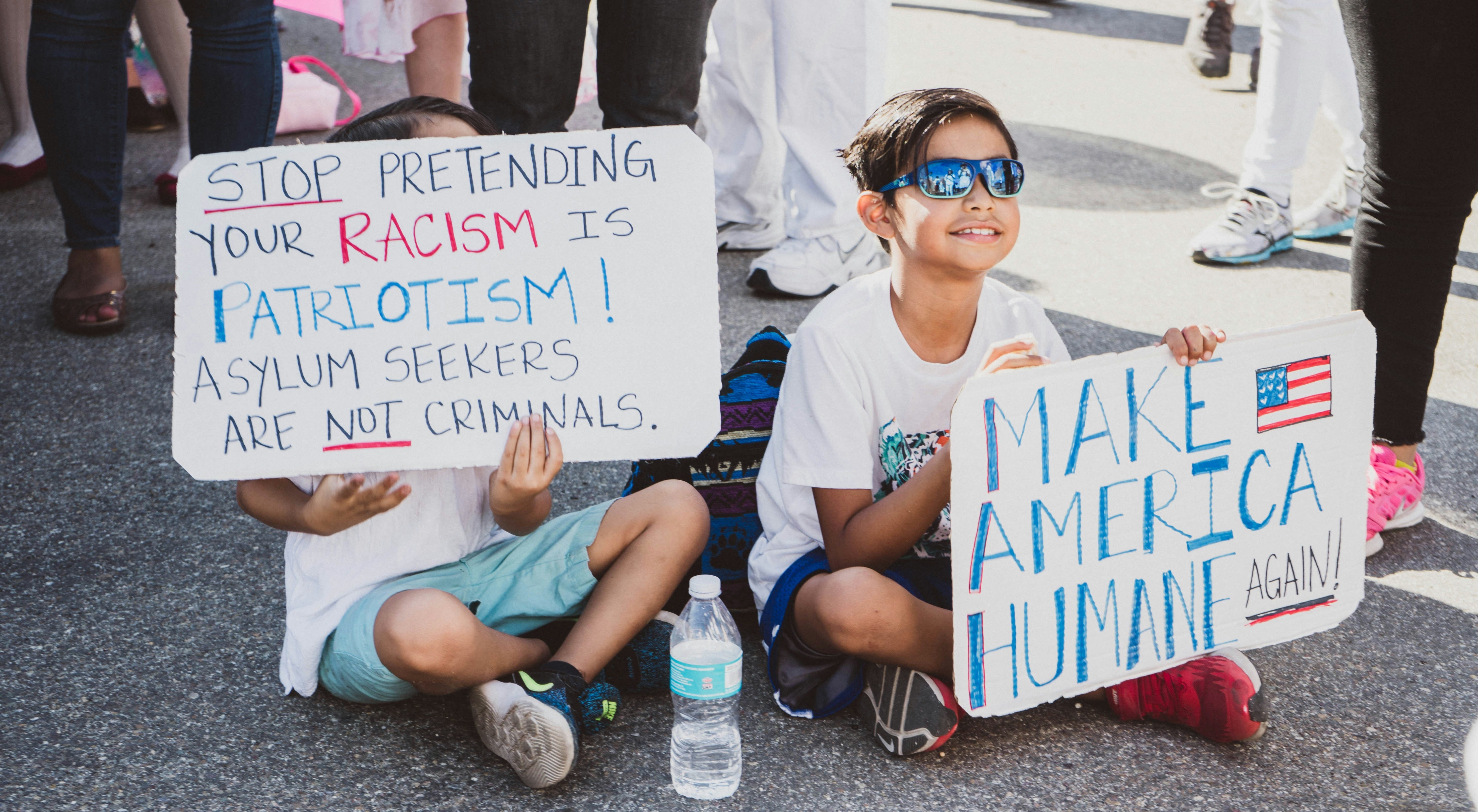
I stand with the children placards
They know the truth about things happening now.