

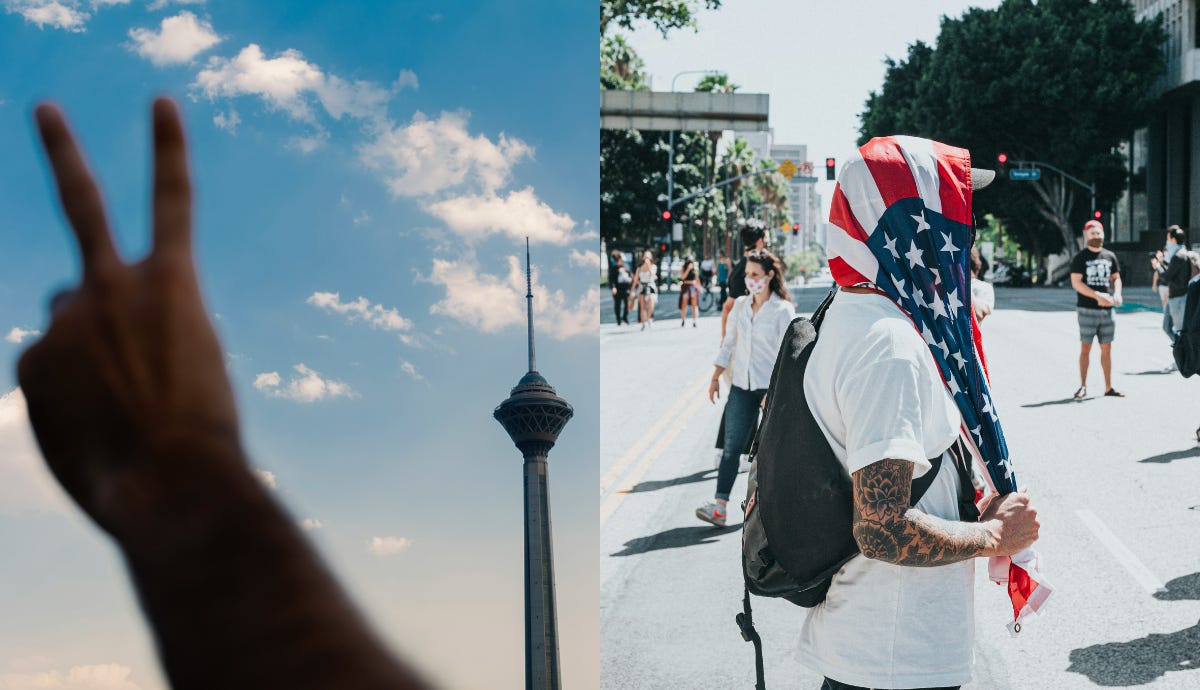
The terror being unleashed in Iran is unfolding alongside a quieter, but still unsettling, sense of terror here in the United States.
I feel my childhood self creeping back into the room. A loved one recently told me thatas a person of color, they “liked America when they were in third grade,” as if it were a childhood phase like Silly Bandz. It was said in response to a video I made about a more ideal world, and about an America that might actually live up to its stated values by reckoning honestly with its racialized and gendered class dynamics. An America that could be a real beacon for Iranians seeking freedom and self-expression. But maybe that version of America has always been closer to fantasy than memory.
The instability here is not comparable to what people are facing in the streets of Tehran or Qom. Still, we are living in the aftermath of an ICE agent shooting Renee Nicole Good, a legal observer, amid community fear over armed and masked immigration agents racially profiling neighbors. After receiving mixed signals from officers, Good attempted to leave the scene and was shot multiple times as she turned her car away. In the aftermath, she has been publicly denigrated for being a lesbian and for being framed by the person occupying America’s highest office as an agitator.
Months ago, I wrote about the aftermath of Tanzania’s elections, where an internet blackout followed widespread allegations of fraud.
Two Silences

This past August, I wrote about the U.S. Constitution and how it hasn’t been amended in over thirty years. This is the second-longest constitutional pause in our nation’s history. The last amendment? A leftover from 1789 that was finally ratified in 1992, this measure was intended to delay congressional pay raises until after elections. Hardly the kind of democratic upgrade you put in a museum display. And yet, it feels emblematic of the era that followed: decades of institutional inertia, partisan gerrymandering, and a Congress more interested in preserving power than modernizing the machinery of governance.
At the time, human rights groups and regional observers warned that excessive violence and mass detentions were occurring beyond the reach of verification. What was murky then has since grown clearer. A recent investigative report confirmed that during the blackout, security forces in Mwanza used lethal force against civilians, removed bodies from the streets, and left families without answers. Months later, there is still no official death toll, hundreds remain unaccounted for, and the state continues to deny responsibility.
Which raises an uncomfortable question: who could really know what happened (or what is still happening) outside of the people doing the slow, dangerous work of documentation? In Tanzania, it took leaked police files, survivor testimony, forensic analysis, and investigative journalism to reconstruct what the blackout was designed to erase. Those same civil society actors are often dismissed by political leaders as part of an “NGO-industrial complex” for findings that are inconvenient.
That question takes me back to the reactions to my video about Iran. It is possible to hold real anger toward elected officials while still pushing for an idealism that once drove American progress. It is possible to hope (even now) that the symbolic meaning of self-government still matters to people watching from places where dissent is met with prison or death.
But as a person of color living in the long aftermath of White fragility destabilizing a superpower over the existence of a Black president, and amid backlash against a more honest, pluralistic vision of the American melting pot, it’s hard not to see American ideals as something treated like a childhood fad, which eventually becomes something outgrown and something discarded. Especially once you come to terms with the nation not only as a democracy, but as an empire built on labor exploitation, brilliant marketing, and racial manipulation that concentrates power and wealth at the top.
References
Al Jazeera. “Iran Protests Live: Tehran Says Trump Encouraging Political Destabilisation.” Al Jazeera, January 14, 2026.
https://www.aljazeera.com/news/liveblog/2026/1/14/iran-protests-live-tehran-says-trump-encouraging-political-destabilisation.CNN Staff. “Iran Protests Live Updates: Trump Comments, Crackdown Continues.” CNN, January 14, 2026.
https://www.cnn.com/world/live-news/iran-protests-trump-01-14-26.(Chicago allows “Staff” when no individual author is listed.)
Deutsche Welle. “DW Exclusive: Post-Election Violence in Tanzania’s Mwanza.” DW, January 2026.
https://www.dw.com/en/dw-exclusive-post-election-violence-in-tanzanias-mwanza/a-75473767.

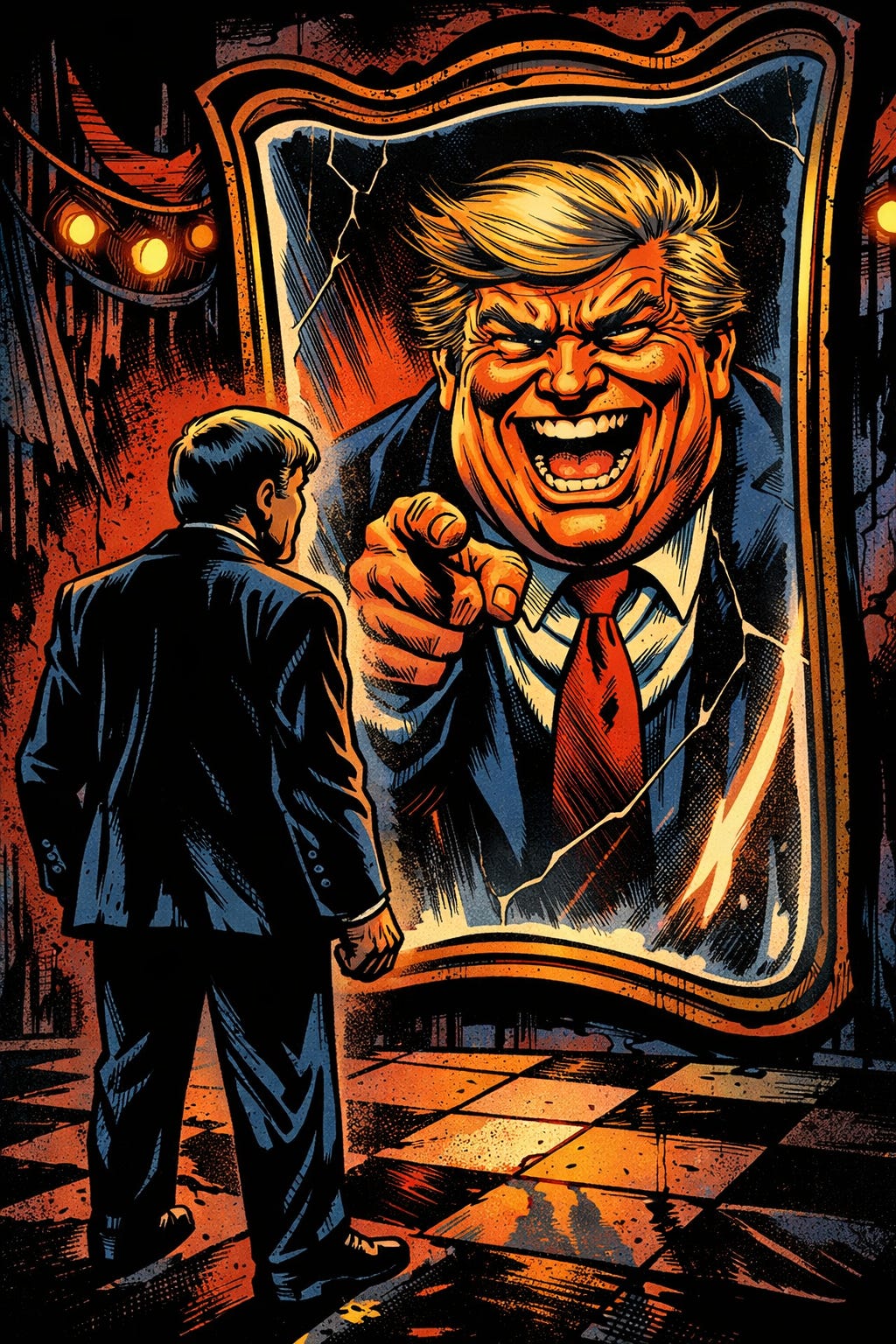
So the president recently flipped off a detractor after delivering remarks to the Detroit Economic Club, following a tour of a Ford plant. He reportedly told someone, “F**k you.”
This is the President of the United States.
I want to be generous here. Most people do not follow politics as a discipline. They aren’t reading speeches, tracing communications strategies, consulting primary sources, or situating events within historical patterns. They encounter politics the way one encounters weather through fragments, headlines, and the cult-of-personality broadcast hour that filters everything into entertainment. That isn’t a moral failure by itself. It’s how politics has been redesigned for consumption.
But we are now approaching a decade of something deeper than tone or decorum. A decade of unapologetic racism, skeevy sexism, fixation on women’s bodies, open contempt for governance as a serious responsibility, and the substitution of reality-television spectacle for democratic leadership. At some point, the repetition becomes the story.
I agree with those who argue that Trump is a reckoning for a leadership class that hollowed out American civic life long before he arrived: insider trading masquerading as expertise, the wreckage of Reaganomics, irresponsible campaign and pundit gamesmanship, and an elite culture that laundered its own insecurities into dominance contests over who sounded smartest while dismissing unpolished perspectives as unserious. That was the Washington Consensus of the neoliberal and neoconservative age.
But voters are not exempt. Watching people in other countries bleed for their rights while a significant portion of the electorate here votes out of identitarian spite (or treats cruelty as a form of authenticity) is not just hypocrisy. It is a case study in how decadent empires behave when hierarchy feels more emotionally satisfying than democracy. No one is born into that posture.
It is learned, rewarded, and normalized.