
Author’s Note: Once again, I had a lot to say this morning. Bear with me.
Yesterday, I recorded a video about my thoughts and my own evolution regarding the “Vote Blue No Matter Who” stance I found myself in from Trump’s first term until 2024.
The feedback was… enlightening. Some folks accused me of being on the Trump payroll. Others said they’d vote blue no matter who. Others suggested I should declare myself independent (I have since I was voting age). On the face of it, this was just typical internet craziness. But what it showed was something much more significant: emotions are now attached to the concept of democracy itself in a country that seems to be going backwards.
For years, I observed the Democratic Party expand its tent to center-right defectors in response to Trump’s hostile takeover of the Republican Party. It made sense. Coalitions change, history is messy, and emergencies make strange bedfellows.
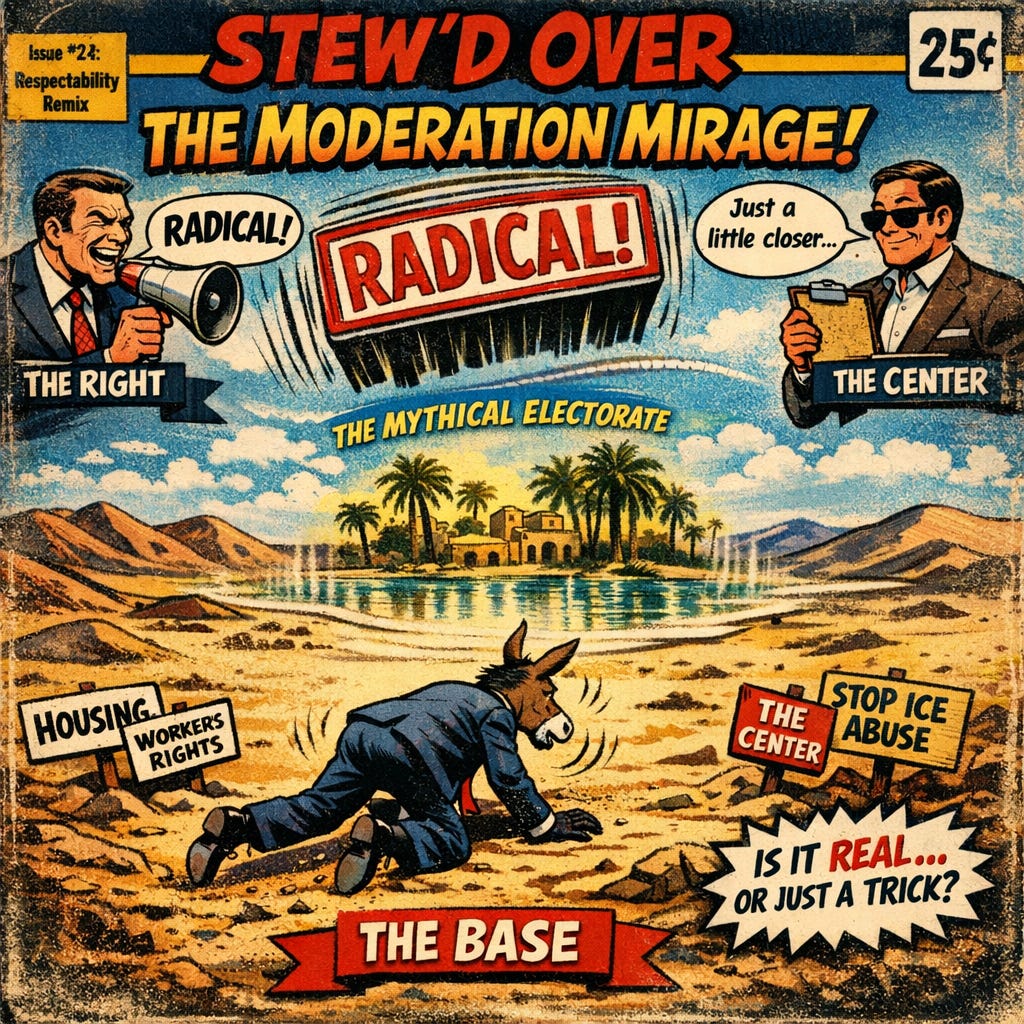
However, over time, what had been a necessary strategy began to appear like a problem in that triangulating between the far right and the center right is not simply “winning elections” but distorts the party’s imagination, shrinking the possible while pushing away those who live with the consequences of austerity, racialized policing, and the erosion of bodily autonomy. This moment would come to be characterized by a dubious debate over whether Trump was “true conservatism” while the party pursued a delusional constituency more invested in rearticulating right-wing discourses than in imagining a future that feels possible.
And I’ve altered my perception of the stakes. I no longer look at the Democratic unraveling as just another installment in the long history of dysfunctional political machinery. I see it as an existential risk to people’s safety and well-being, because the country is now operating under the influence of nationalistic and identitarian forces that do not believe in plural democracy.
But here’s the tough part: a party that is unwilling to specify the failures of the old center-right consensus that led this country into the 21st century can’t seriously claim it’s “saving democracy.” A party that is unwilling to engage America’s history of racialized power, industrial aristocracy, and managed inequality becomes an obstacle to justice, even if it brands itself as “anti-Trump.” And yes, this is how it markets itself. But that’s branding, and it can be far from the truth.
Let me give you an example.
Gavin Newsom has been criticized for pandering to right-wing thinking through “reach across the aisle” media appearances, such as his with Ben Shapiro, in which he disavowed his own administration’s use of ICE and agreed with Shapiro that ICE agents are “not terrorists,” sparking outrage on the left. Whether or not the particular statement is true is almost irrelevant; the political impact is to legitimize right-wing assumptions and to police Democratic discourse in the direction of “reasonable” respect.
Elissa Slotkin used Ronald Reagan in her televised Democratic response to Trump’s speech. Reuters called it reaching for the political center. Again, I’m not saying that using Reagan is illegal. I’m saying, why is a party that is under threat of authoritarianism still using Reagan as a non-partisan way to talk about legitimacy? What does that say to the people who lived through that period about the abandonment of the rights revolution’s gains?
Ruben Gallego is under progressive fire for sponsoring or cosponsoring enforcement-oriented immigration bills (such as the Laken Riley Act) for what some argue is the Democrats’ continued absorption of the right’s border narratives rather than challenging the racialized and ahistorical impulses behind them. This is not theoretical. This comes as ICE practices are sparking scandals that border on the lawless: in Minnesota, a U.S. citizen alleges ICE agents yanked him from his home almost naked in subfreezing temperatures during an operation, while a family with six children, including a six-month-old, was caught in tear gas during an ICE protest response.
And then there’s Chuck Schumer, whose leadership tends to devolve into strongly worded concern as the base watches rights, material conditions, and democratic legitimacy get treated like bargaining chips. (I’ll resist the urge to be snarky here: letters aren’t leverage.)
Behind all of this is the intellectual and media environment that conditions Democrats to always be moving to the right while lecturing the left. The progressive critique of the “pod bro” and centrist commentary world isn’t personal, but structural. It contends that the right is treated as a views marketplace rather than a political project funded and amplified by capital, using fear of the other to wield cultural power over unpopular policy. A sign of this struggle is the reaction to Ezra Klein’s “Charlie Kirk Practiced Politics the Right Way” take, which abstracted the persuasion strategy from the project it was meant to serve.
You see this same thinking in institutional memos and “pragmatist” strategy briefs. In response to ICE violence and escalating tactics, centrist groups like Third Way and Searchlight Institute called on Democrats to move past “Abolish ICE” talk and into “reform and retrain” speak. I am not saying that slogans are policy. I am saying that this impulse to police optics, to temper criticism, and to safeguard the center is taking place while people are living through the consequences.
This is why I don’t buy the demand for silence dressed up as unity. Black women who’ve long been overrepresented in public-sector and stability-seeking jobs because private-sector “meritocracy” has never been neutral are now getting squeezed out when the economy tightens and when institutions decide inclusion was a trend, not a commitment. Meanwhile, Diversity, Equity, and Inclusion (DEI) gets rolled back, disclosure gets scrubbed, and whole sectors quietly re-Whiten without anyone needing to announce a policy. So when people respond to critique with “stop helping Trump” or “vote blue no matter who,” what they’re really asking is that the people absorbing the losses stop speaking long enough for the brand to survive.
I write all of this with grace towards the figures I’ve mentioned. These are tough jobs in a large, argumentative country. But grace is not silence, and unity is not obedience. We need a Democratic Party that is prepared to lead and imagine beyond the frameworks it has inherited, beyond the talking point complex that punches left while treating right-wing narratives as the default reality.
This is why I created the video about the skepticism of “Vote Blue No Matter Who.” Votes must be earned, particularly from communities of color who have been watching this offensive circus roll back the gains of the past fifty years while Democrats offer procedural maneuvers and restoration daydreams. If the only pitch is “we’re not Trump,” and the only strategy is “discipline the left,” then it’s not a coalition.
It’s a brand maintenance plan.
And I’m not interested in being managed. I’m interested in freedom and accountability.
References:
Hall, Orion. “Sen. Gallego’s Laken Riley Act Sponsorship Exemplifies the Dems’ Strategy Failures.” Common Dreams, February 15, 2025. https://www.commondreams.org/opinion/gallego-laken-riley
Borter, Gabriella. “Democratic Senator Slotkin Reaches for the Political Center in Rebuttal to Trump.” Reuters, March 5, 2025. https://www.reuters.com/world/us/democratic-senator-slotkin-reaches-political-center-rebuttal-trump-2025-03-05/
ModerateProgressive1. “After Newsoms Interview With Ben Shapiro Is It Fair to Say That the Majority of the Credit He’s Received for Being a ‘Fighter’ Belongs to His Twitter Staffers and Not Himself?” Reddit, r/AskALiberal. https://www.reddit.com/r/AskALiberal/comments/1qif93f/after_newsoms_interview_with_ben_shapiro_is_it/.
Associated Press. “US Citizen Says ICE Forced Him From His Home Without Clothes in Subfreezing Weather.” The Guardian, January 20, 2026. https://www.theguardian.com/us-news/2026/jan/20/citizen-ice-minnesota-thao
Klein, Ezra. “Charlie Kirk Assassination Fear Politics.” The New York Times, September 11, 2025. https://www.nytimes.com/2025/09/11/opinion/charlie-kirk-assassination-fear-politics.html
Coates, Ta-Nehisi. “Charlie Kirk, Redeemed: A Political Class Finds Its Lost Cause.” Vanity Fair, September 16, 2025. https://www.vanityfair.com/news/story/charlie-kirk-ezra-klein-tanehisi-coates
The Conference Board. “Report: Big US Companies Are Disclosing Less of Their Work in DEI… But That Doesn’t Mean They’re Abandoning DEI.” Press release, August 4, 2025. https://www.conference-board.org/press/corporate-diversity-disclosure-2025
Holloway, Kali. “Trump’s Slash-and-Burn Economy Is Devastating Black Women.” The Nation, January 14, 2026. Republished in Ripple by The Washington Post. https://www.washingtonpost.com/ripple/2026/01/13/trump-economy-black-women/
Wilson, Valerie. “What’s Behind Rising Unemployment for Black Workers?” Working Economics Blog (Economic Policy Institute), September 19, 2025. https://www.epi.org/blog/whats-behind-rising-unemployment-for-black-workers/
Corbett, Holly. “Women Made Up Nearly All the Job Losses Last Month. Here’s Why.” Forbes, January 14, 2026. https://www.forbes.com/sites/hollycorbett/2026/01/14/women-made-up-nearly-all-the-job-losses-last-month-heres-why/

I would like to use this paid section to answer a question that has been in my head for a while: Is it a problem that the Democrats have deferred to strategists who constructed the right-wing machine that has completely discredited their brand in the entirety of my lifetime (I am 31 years old) in the 2024 election?
Can that have been the reason why the Democrats lost a winnable election, rather than “wokeness”?
And was the strategist’s logic that led to a Kamala Harris and Liz Cheney “Avengers Assemble” moment actually a misreading of the room, more interested in restoration than imagination?
I ask this question because I have a deep respect for what Liz Cheney and many of the Never Trump Republicans did over the years. I don’t dismiss the bravery that it took to go against a party that had become overtly hostile to pluralism and democratic restraint. But at the same time, I feel like the reckoning for how they practiced politics has yet to be fully realized. It leads us to believe in a conservatism that wouldn’t have spawned Trump, even though the gender, racial, religious, and sexual hatred was always the underlying message on the campaign trail, with legal claims of originalism rooted in a time that enslaved people, and the relevant hum beneath the rallying cries of “states’ rights” and “small government.”
This is a framing that has always been used to empower those who lived through a time of actual institutional effort to address the history of anti-Black destruction, gendered hierarchy, and economic displacement. It is easy to think that ideas are good when those institutions were largely homogeneous and lacked the lived experience that those claims of “welfare queens” and “states’ rights” actually hurt. It is easy to sanitize cruelty with “fiscal responsibility” when the constituent that is harmed by it is silenced at the voting booth, lives in a state that finds new ways to update discrimination and segregation, and is told to view the injury as either a personal failing or an unfortunate but necessary cost of order.
In this regard, I concur with most Never Trump intellectuals who point to Stuart Stevens’s It Was All a Lie as their main text. This is because, even if it wasn’t all a lie, many who subscribed to pluralism and the esoteric architecture of conservative identity in America were being lied to by others with a profoundly human, but primal, need to reify hierarchy in the traditional American setting.
So when the Democrats constructed a restoration coalition in 2024 and when they set “normal” as the destination and “bipartisanship” as the proof of virtue, they were not merely running a campaign. They were running a theology. And the thing about theology is that it doesn’t translate well to a population living through material insecurity, institutional breakdown, and a political right that has ceased pretending it’s playing the same game.
This is what I mean when I say that the 2024 campaign was driven by a desire to restore rather than reimagine.
It appeared in particular locations, not just atmospheres. The campaign was all about respectability politics and “moderation signals” regarding energy policy, the border, “public safety,” and what forms of solidarity were to be expressed on stage. It did the classic triangulation dance move: take the right’s territory seriously, signal to the “center,” and then act surprised when you’re still labeled as radical by folks who believe any democracy that includes “others” is radical.