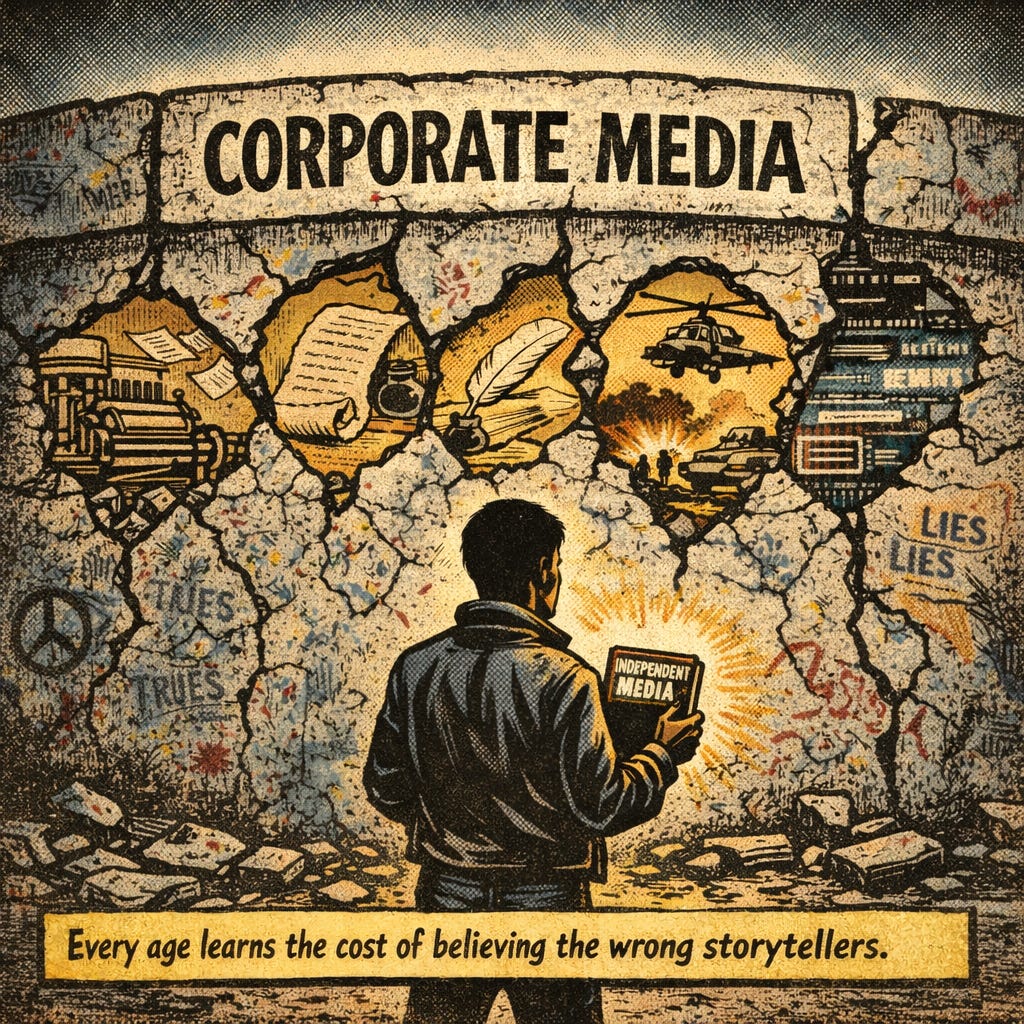



Another Terrible Weekend in the Media
Independent media is more important than ever, and this weekend offered a near-perfect illustration of why.
The New York Times published a piece on JD Vance’s speech at Turning Point USA under the headline: “Vance Refuses to Take Sides in G.O.P. Fight Over Bigotry.” That framing is not neutral. It is the story’s first and most consequential act of misdirection. To describe a refusal to confront antisemitism, racism, and conspiracy politics as not taking sides is to smuggle moral abdication into the language of statesmanship.
Bigotry is not a policy disagreement. It is not a factional squabble. And refusing to take sides in a fight over it is itself a choice.
Buried deeper in the article is the line that should have anchored the entire piece: Vance’s declaration that “you don’t have to apologize for being White anymore.” The Times frames this as part of a “big tent” appeal, an effort at coalition maintenance. In reality, it is the distilled grammar of modern White grievance politics and language designed to reframe dominance as victimhood and exclusion as fairness.
Vance has long relied on coded rhetoric and strategic ambiguity to evade scrutiny while playing to the GOP’s modern project of laundering White identity politics into electoral respectability. Treating that maneuver as a mere campaign strategy rather than a theory of power is not objectivity.
It is narrative sanitization.
This is not an isolated failure. The New York Times has been under sustained scrutiny throughout the Trump era for clinging to an increasingly hollow understanding of neutrality. It is arguably one that mistakes procedural balance for moral clarity in an age of democratic backsliding. In a media ecosystem defined by 24/7 cable churn, algorithmic amplification, and corporate incentives, authoritarian politics do not need censorship to thrive, not when they get normalization by the national paper of record.
When a clear dog whistle is framed as just another applause line, we normalize policy violence. Draconian immigration regimes, collective punishment, and even the deportation of citizens become abstractions or debate topics rather than human crises.
That same institutional failure surfaced again this weekend at 60 Minutes, where a fully reported and legally vetted segment on Venezuelan migrants sent to a notorious El Salvadoran prison was pulled just hours before airtime. The journalist responsible for the piece later told colleagues that the decision was political, not editorial. The reporting had passed every safeguard that has undergirded half a century of 60 Minutes standards. The only missing “perspective” was cooperation from the White House. Apparently, it is a prerequisite rather than an opportunity for accountability.
This decision follows the rise of Bari Weiss within CBS leadership and underscores a deeper rot. When the absence of power’s consent becomes grounds to suppress reporting, journalism ceases to function as a watchdog and instead becomes a stakeholder.
We may be witnessing the slow death of corporate media as it once understood itself, not through overt censorship, but through risk aversion disguised as fairness. When human rights abuses and racialized nationalism are framed as just one side of a reasonable debate, rather than what they are, a struggle over the preservation of white supremacy in a country built on its assumptions, the result is not balance, but historical illiteracy.
And when news is treated less as a democratic necessity and more as a profit driver or investor asset, this is what we are offered in return: polished prose, hollow neutrality, and Orwellian gobbledygook that gently talks the public into accepting the unacceptable.

The Long Memory of Media Failure
I grew up a journalism nerd and still take shots at my own self-confidence for not following a traditional media career path by first working at think tanks openly critical of corporate press, then moving through political communications from the vantage point of advocacy rather than donor-class or corporate narrative building. Coming from a competitive background, the traditional route was presented as a measure of worth, legitimacy, and arrival.
But watching the breakdown of corporate media in real time, I increasingly wonder whether the road I didn’t take was never really mine to begin with. Whether the detours, intentional and accidental, were preparation. Whether this was always the vantage point I was meant to occupy.
Societies in transformation, whether toward liberation or collapse, reveal themselves most clearly through their media systems. The printing press did this during the Catholic Reformation, when papal authority relied on extracting money from impoverished populations still trapped in feudal deference, while preaching moral discipline it did not practice itself. Pamphlets didn’t just spread heresy; they exposed hypocrisy. Authority fractured because narrative control fractured.