



January 6 and the Loaded Dice of American Politics
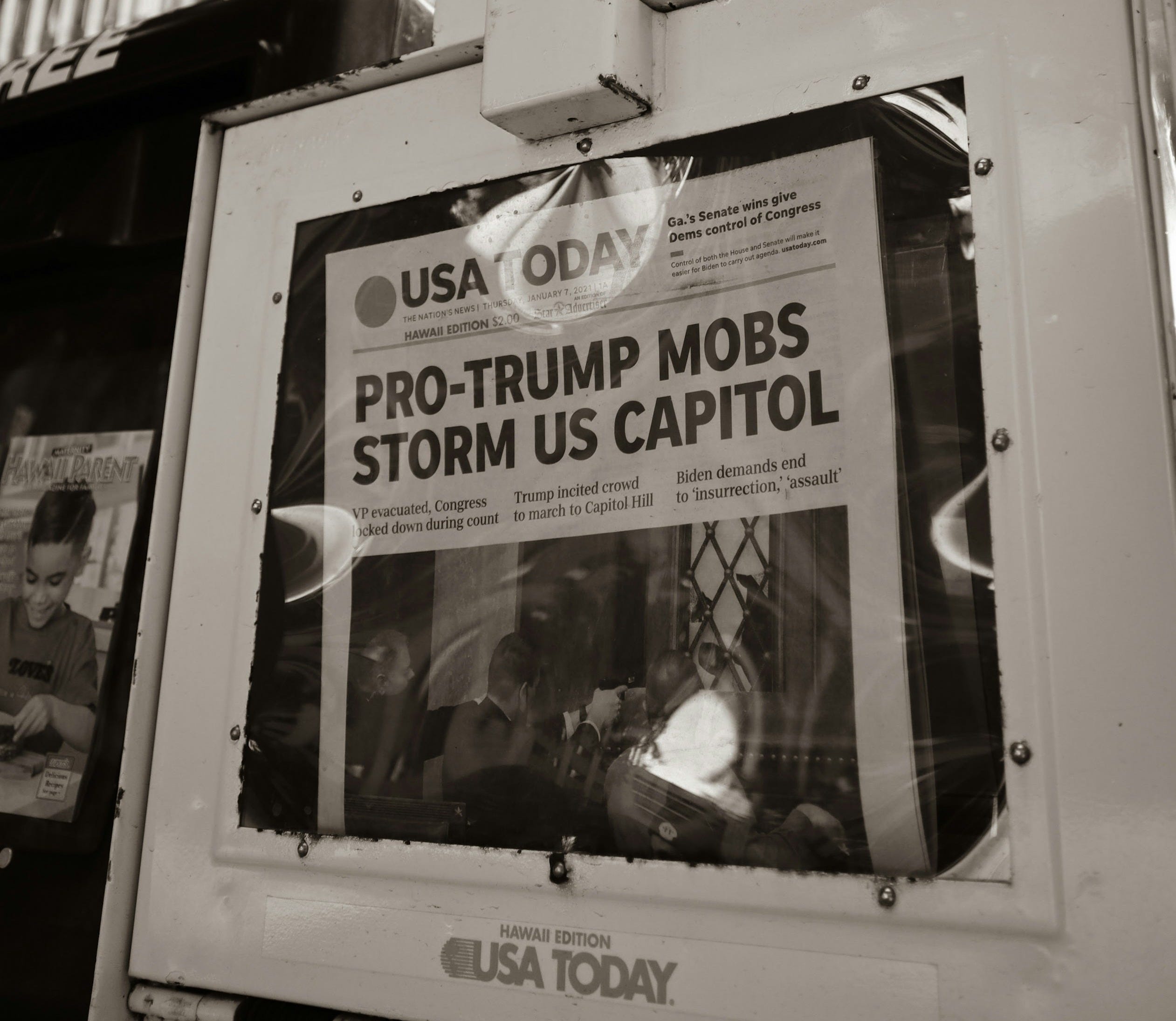
It is not unbelievable that today marks the fifth anniversary of the January 6 attack on the U.S. Capitol. What is striking, five years on, is how familiar it all feels.
The months leading up to January 6, 2021, were not chaotic in the abstract; they were methodical. A sitting president waged a sustained campaign to delegitimize an election he had lost, seeding distrust through rallies, tweets, cable news appearances, court filings, and rhetorical proxies. When Congress moved to certify the electoral count, that same president publicly singled out his vice president as the final obstacle to overturning the result. The message did not instruct violence. It did not need to.
This unfolded amid a global pandemic that had fractured social trust, isolated millions of Americans, and collapsed shared reality itself. Some people mourned loved ones in solitude, while others dismissed the virus as a hoax engineered to destroy a political avatar. Anxiety, grievance, and epistemic confusion were already circulating freely. January 6 did not erupt from nowhere. It arrived on time.
The aftershocks of that moment still define American political life. Despite a bipartisan congressional committee's findings documenting extensive efforts to undermine the peaceful transfer of power, Donald Trump was reelected in 2024. The lesson absorbed by the political system was not repudiation but accommodation. Elite-driven political disorder, once shocking, is now folded into the normal rhythms of American governance.
This was not the first rehearsal.
Disorder as Strategy: From Florida 2000 to January 6
The Brooks Brothers riot during the 2000 election was not a spontaneous outburst of civic passion. It was a coordinated effort by Republican operatives to physically disrupt the recount in Miami-Dade County after Al Gore challenged the results in Florida. Protesters, many of whom were later revealed to be congressional staffers and party insiders, stormed the counting center, banged on doors, intimidated election officials, and succeeded in halting the recount.
That outcome mattered because the disruption worked, and the recount stopped. The Supreme Court soon intervened, and the lesson was clear: procedural chaos, when laundered through respectability and legal ambiguity, could shape political outcomes without consequence.
Twenty years later, the scale was different, but the method remained the same.
January 6 was the Brooks Brothers riot with a mass audience, a digital megaphone, and a president willing to let probability do what he could not lawfully command.
Stochastic Terrorism and the Logic of Probability
This is where the concept of stochastic terrorism, as articulated by Molly Amman and J. Reid Meloy, becomes analytically clarifying rather than rhetorically convenient.
Stochastic terrorism describes a process in which public demonization and threat-laden rhetoric increase the statistical likelihood of violence without issuing direct orders. The term “stochastic” is precise: outcomes are unpredictable at the individual level but increasingly probable at the population level.
Amman and Meloy emphasize that this is not command-and-control radicalization, but atmospheric conditioning. Through linguistic pragmatics and the ways meaning is shaped by repetition, framing, moral implication, and social reward, leaders construct a narrative environment in which violence becomes thinkable, then defensible, and finally inevitable for someone.
Crucially, stochastic terrorism thrives in the gap between moral responsibility and legal culpability. U.S. incitement law requires intent and imminence, while stochastic terrorism operates without either. The speaker does not need to want violence to occur; it is enough to tolerate the risk while continuing to load the dice.
January 6 fits this model with chilling precision. Even if one accepts the claim (generously) that Trump and his allies did not intend a riot, the probability of violence was not an accident. It was an unpriced externality of months of delegitimization, apocalyptic framing, and targeted grievance.
Someone, eventually, was going to act.
Jack Smith and the Limits of Law
This distinction matters when assessing the legacy of Special Counsel Jack Smith. Smith terminated his investigation after Trump’s reelection, adhering to longstanding Department of Justice norms against prosecuting a sitting president. That procedural ending has been misread by many as substantive exoneration.
It was not.
In recently released closed-door testimony to Congress, Smith stated that he believed the evidence would have supported a conviction beyond a reasonable doubt for conspiracy to overturn the 2020 election. That claim does not require proof that Trump ordered a riot. It requires demonstrating participation in a coordinated effort to subvert lawful electoral processes.
Stochastic terrorism explains why both things can be true at once: legal accountability can fail even when political culpability is overwhelming. The law asks narrow questions about intent, and history asks broader ones about consequence.
What January 6 Changed
The Republican Party’s institutions and media ecosystem have worked diligently to memory-hole January 6 or reframe it as partisan persecution. That effort has not entirely succeeded, and the public remembers. What has changed is the political cost of remembering.
Centrist forces lost the 2024 election not because voters forgot January 6, but because they were offered a politics that treated it as an aberration rather than a warning. Messaging is obsessed with norms while ignoring the conditions that made norm-breaking effective in the first place.
January 6 was not the day democracy died. It was the day probabilistic political violence became normalized at the elite level of American life as deniable, repeatable, and survivable for those who flirt with it.
The danger is not that everyone will riot. The danger is that someone will always, and those at the top will continue to pretend this is random, unforeseeable, and not their responsibility.
The dice are already loaded. History will not pretend otherwise.
References
Amman, Molly, and J. Reid Meloy. “Stochastic Terrorism: A Linguistic and Psychological Analysis.” Perspectives on Terrorism 15, no. 5 (2021): 2–13. https://www.jstor.org/stable/27073433.

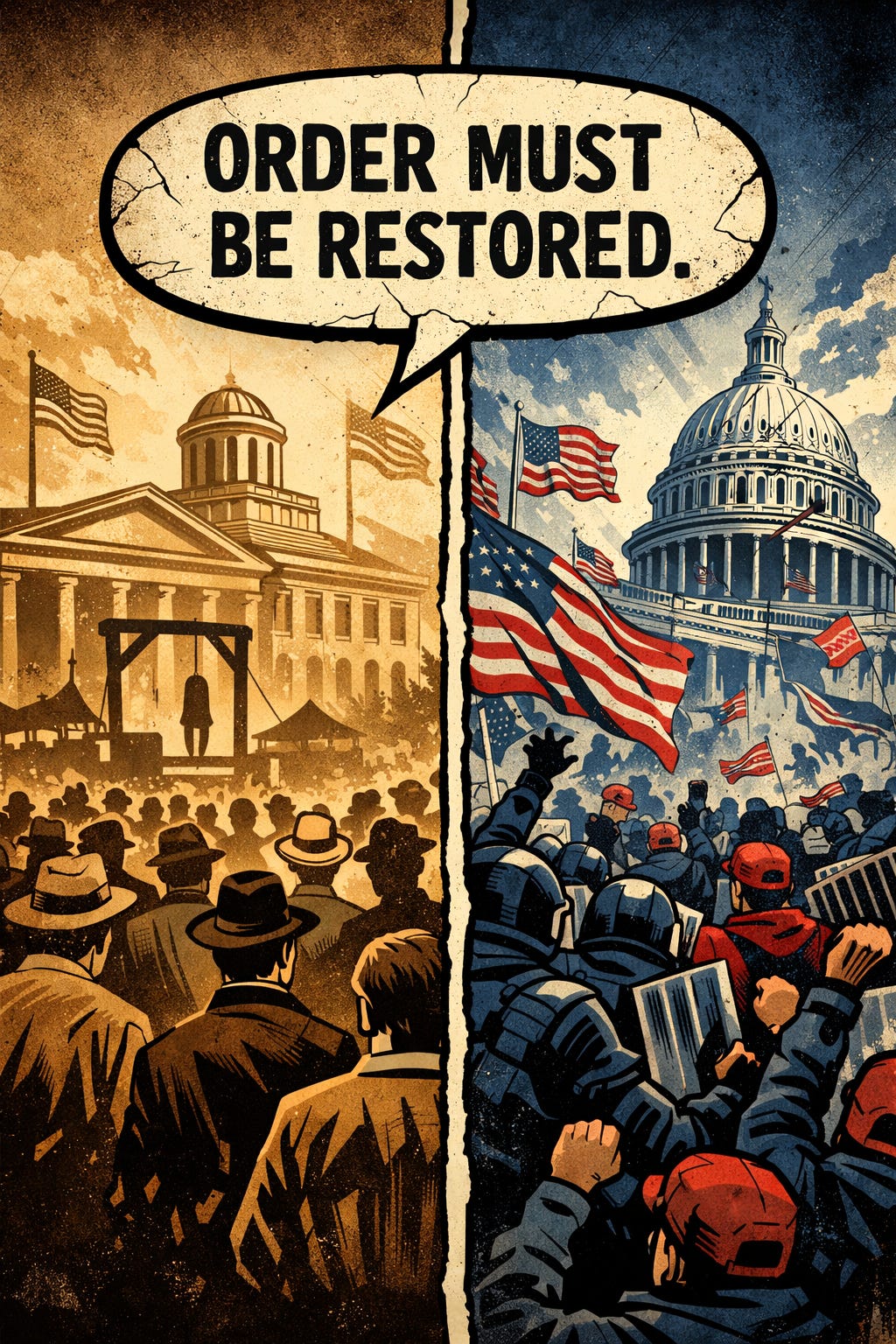
As a Black American, this is a uniquely frightening moment. Not abstractly scary and not just intellectually alarming, but frightening in the way history lives in the body. Black bodies have been at the center of American political violence from the beginning, rationalized in the name of order. When a society begins to normalize open political violence again, even probabilistically, the instability does not announce itself politely. It settles into muscle memory, and you feel it in your bones.
A paid subscription gets you:
Full access to the archives
The ability to comment and join the conversation
Stew’d Over, and other bonus daily newsletters!
Live Ask Me Anything sessions with paid readers — coming 2026!
This independent work is sustained by readers who want more than headlines and hot takes. Offer ends tonight!
