
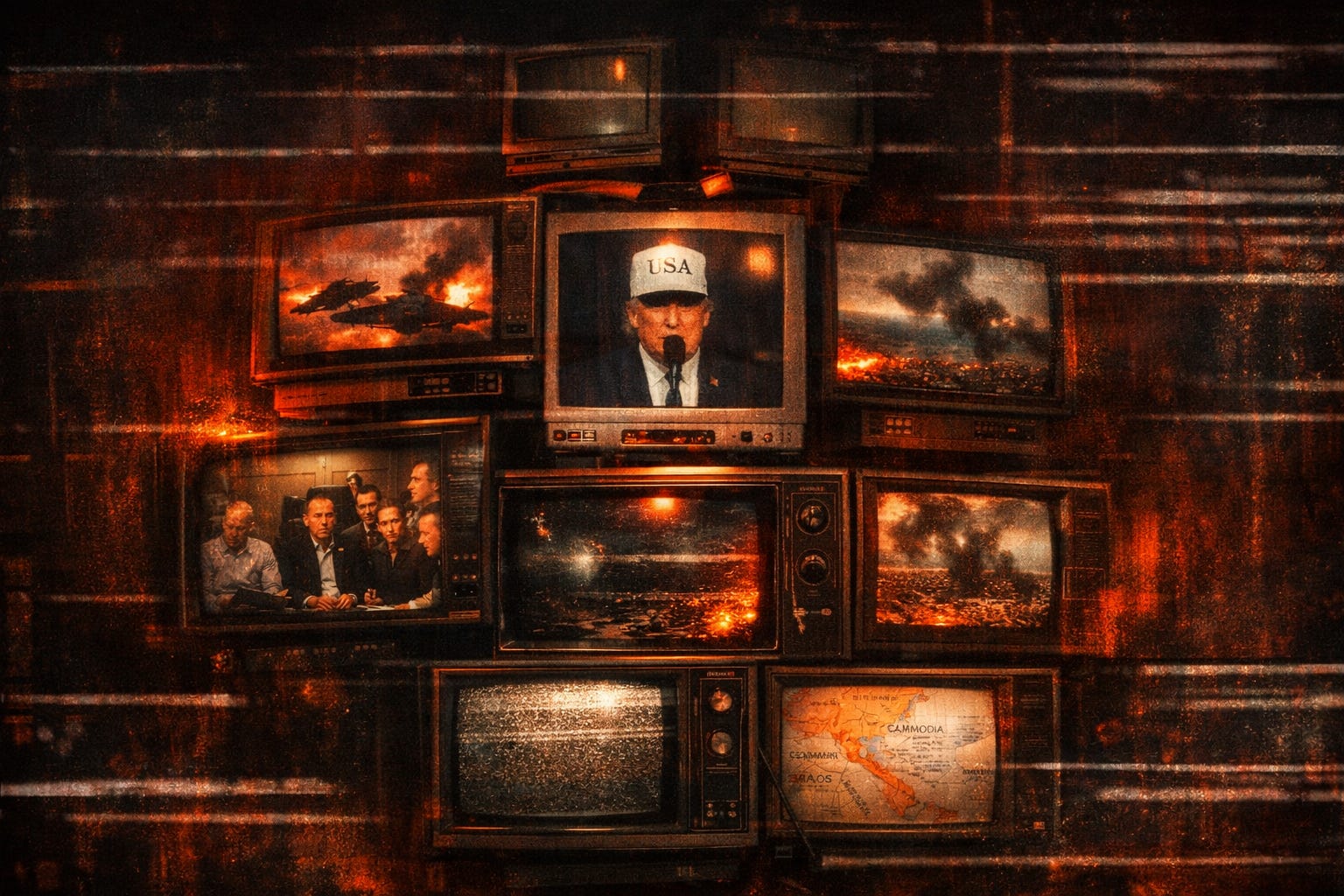
Soft Power, Hard Empire
What happens when legitimacy fails but coercion remains?

We crossed the Rubicon of waging wars through lies and deceit a long time ago. Not once, not as an aberration, but as a recurring feature of an American political technology refined for the television age. Gulf of Tonkin offered the script: a contested incident becomes a clean moral headline, and the headline becomes a blank check. Iraq perfected the sequel with intelligence becoming theater, dissent becoming disloyalty, and “we’ll be greeted as liberators” becoming the kind of sentence that ages like milk left in the desert. By the time the smoke clears, the public learns what it always learns: that it was not lied to by accident but persuaded on purpose.
Now we are looking at a situation where a president can move toward war with thin democratic consent and thinner allied legitimacy, and where the constitutional choreography meant to slow the march to violence feels more like a museum exhibit than a living restraint. Congress was designed to be the jealous custodian of war powers. The modern presidency has become its frequent squatter. This isn’t novel in form, but it is ominous in pace and mood: executive action first, justification later, and oversight treated as optional feedback.
What makes this moment uniquely dangerous isn’t merely the prospect of escalation abroad. It’s the domestic political uses of catastrophe. America has a long, disciplined history of discovering new reasons to narrow liberty in the name of survival. In World War I, the state learned that fear is a solvent: it dissolves rights quickly and leaves residue for decades. The Red Scares and Palmer Raids demonstrated how easily dissent can be recast as subversion. World War II taught the same lesson with even more brutal clarity: entire communities can be caged by an administrative pen stroke when the public is told it is “necessary.” And after 9/11, we watched emergency become architecture with surveillance normalizing, secrecy expanding, and the logic of exceptional powers dressed up as a permanent wardrobe.
So when the president and his allies position the United States near a serious national security catastrophe, it isn’t only foreign policy they’re gambling with. It is the balance of power at home. Crisis launders authority as much as it consolidates it. What begins as temporary becomes standard procedure. What is sold as counterterror becomes a broader mandate to police speech, chase “disinformation,” and treat political opposition as a security threat. You don’t need an official dictatorship when you can build a habitual emergency and call it governance.
In this dark theater of national power, the American people occupy a liminal zone where democratic ritual survives even as democratic substance evaporates. Elections remain, but the menu shrinks.
Rights remain, but their enforcement becomes conditional.
Institutions remain, but their independence becomes a punchline.
And yes, it is grotesquely on-brand that this absolutist drift is narrated by a charismatic former TV host and luxury realtor because modern empire rarely announces itself with a crown because it’s already a brand.
All of this becomes easier to understand if we stop treating the United States as democracy incarnate and start analyzing it as a capitalist empire with a democratic accent. Not an empire in the old colonial sense of planting flags everywhere, but in the newer sense: managing a global order through bases, finance, trade rules, coercive sanctions, intelligence partnerships, and a security umbrella that comes with terms and conditions. When American soft power was strong and when “rules-based order” sounded credible, Washington could lead through consent as much as coercion. It could assemble coalitions, persuade allies, and sell its interventions as reluctant acts of stewardship.
But empires are at their most dangerous when they lose the ability to persuade and retain only the ability to compel. That is the phase change we are watching. The pageantry of allies and carefully curated casus belli becomes window dressing. The performance continues, but fewer people applaud because more people have read the reviews. Even the Iraq era showed what happens when legitimacy fractures, and the “coalition of the willing” becomes less a coalition and more of a euphemism for proceeding anyway. When allies refuse buy-in, it signals not just diplomatic disagreement but a deeper erosion of the hegemon, which is leaning harder on hierarchy than partnership.
We can see the legitimacy fracture in real time. European leaders and EU officials have publicly pushed for de-escalation and declined to provide direct military support, especially naval forces, to secure the Strait of Hormuz, emphasizing that they were not consulted and do not recognize this as a shared war aim. Trump’s response chastising allies for refusing to participate only underlines the transformation of the alliance from a shared project into a transactional obligation.
This is not unprecedented; it is the old story in a new costume. When the Iraq invasion splintered allied legitimacy, Washington discovered that “coalition” could be rebranded as “coalition of the willing,” a phrase that roughly translates to we will proceed, and you may applaud later.
In 1956, Britain and France, alongside Israel, invaded Egypt after Nasser nationalized the Suez Canal. The U.S. refused to back the operation and used financial and diplomatic pressure to force a withdrawal, proving that even the closest allies can be disciplined when their war collides with the hegemon’s preferred order.
And this is why Iran sits at the center of the story. Iran is a geopolitical adversary, a symbol, and a test case.
It is where American hard power can be exercised as a demonstration of regional order maintenance, credibility, and deterrence, the imperial vocabulary that never quite says its own name. Escalation with Iran also creates the kind of ambient emergency that justifies the home-front tightening of the screws, calling for more surveillance, more secrecy, more “unity,” less dissent. Foreign policy becomes domestic policy by other means.
To say this is all Trump would be comforting, because it would imply an easy cure: remove the man, restore the republic. But Trumpism is not an asteroid; it is a symptom of decades of neoliberal and neoconservative governance, which built the runway. Not just through wars and market evangelism, but through the steady corrosion of trust, the expansion of executive discretion, and the casual treatment of law as narrative. When democracy was tested on whether it would be universal, whether “for all” meant for all, America hesitated, bargained, and in many places recoiled. That internal failure didn’t stay inside. It became lubricant for the outward mask to slip.
So yes: this may be the end of American soft power as a believable story, and the ramping up of American hard power as the only remaining language. That still means supremacy abroad, but it is supremacy without the apology rule, with an iron fist, marketed as a necessity. An empire, finally exhausted by pretending it is not one, begins speaking more honestly, not in confession, but in command. And history suggests that when states make this transition, they rarely stop at policing foreign adversaries. They bring the methods home because they’ve already learned that the most convenient enemy is the one you can name “within.”


