
Author’s Note: Sorry for the gap in newsletters over the past couple of days. I was on a personal journey that pulled me away from the daily grind of political and historical analysis. I’m back now, and I hope you enjoy today’s edition. Thank you for sticking with me.
With the news that Gallup is adjusting how it calculates presidential approval ratings, it is worth pausing to reflect on the deeper obsession that defines modern political storytelling: the fixation on marginal polling movements as if they were the pulse of the Republic itself.
To be clear, Gallup isadapting and not surrendering. Response rates for traditional phone surveys have cratered over the last two decades, and what once produced robust participation now struggles to reach even a small fraction of Americans. Trust in institutions is down, and media ecosystems are fragmented. So the old model, which calls for a random sample and measuring the national mood, no longer maps neatly onto a society that no longer consumes information in a shared civic space.
But this is also an American-branded mirror, not just a technical adjustment.
Trumpism weaponized polarization rather than creating it as some obsessed with a more noble before times would like us to believe. This wave of politics exposed how deeply negative partisanship structures American political life. Presidential approval has become less about persuasion and more about identity. For most voters, party affiliation predicts approval almost perfectly. With sticky floors and firm ceilings, the real political temperature of the country is not measured in five-point swings but in hardened camps.
In that environment, the concept of a collapsing approval rating as a sign of imminent political consequence feels outdated. A politician who channels grievance, performs combativeness, and activates cultural anxieties can maintain a loyal base regardless of scandal or institutional stress. The appeal is to tribal clarity, not to policy coherence.
This is not new in world history. But it is newly obvious in American civic life.
The old polling assumptions emerged from a different era when politics operated more like a debate over governing competence within a broadly shared national framework. Today, politics operates as identity affirmation in a nation undergoing demographic, cultural, and hierarchical transition. That transition challenges racial and social assumptions once taken for granted. When those assumptions are destabilized, politics becomes zero-sum in the minds of those who feel displaced.
Pollsters must adjust methodology because the bigger change is sociological. Politics has become less rational in the classical sense and more expressive in a way that is rooted in social belonging, antipathy, resentment, and fear. The numbers still matter, but their meaning has changed.
And that is where the gamesmanship analysis begins to feel hollow.
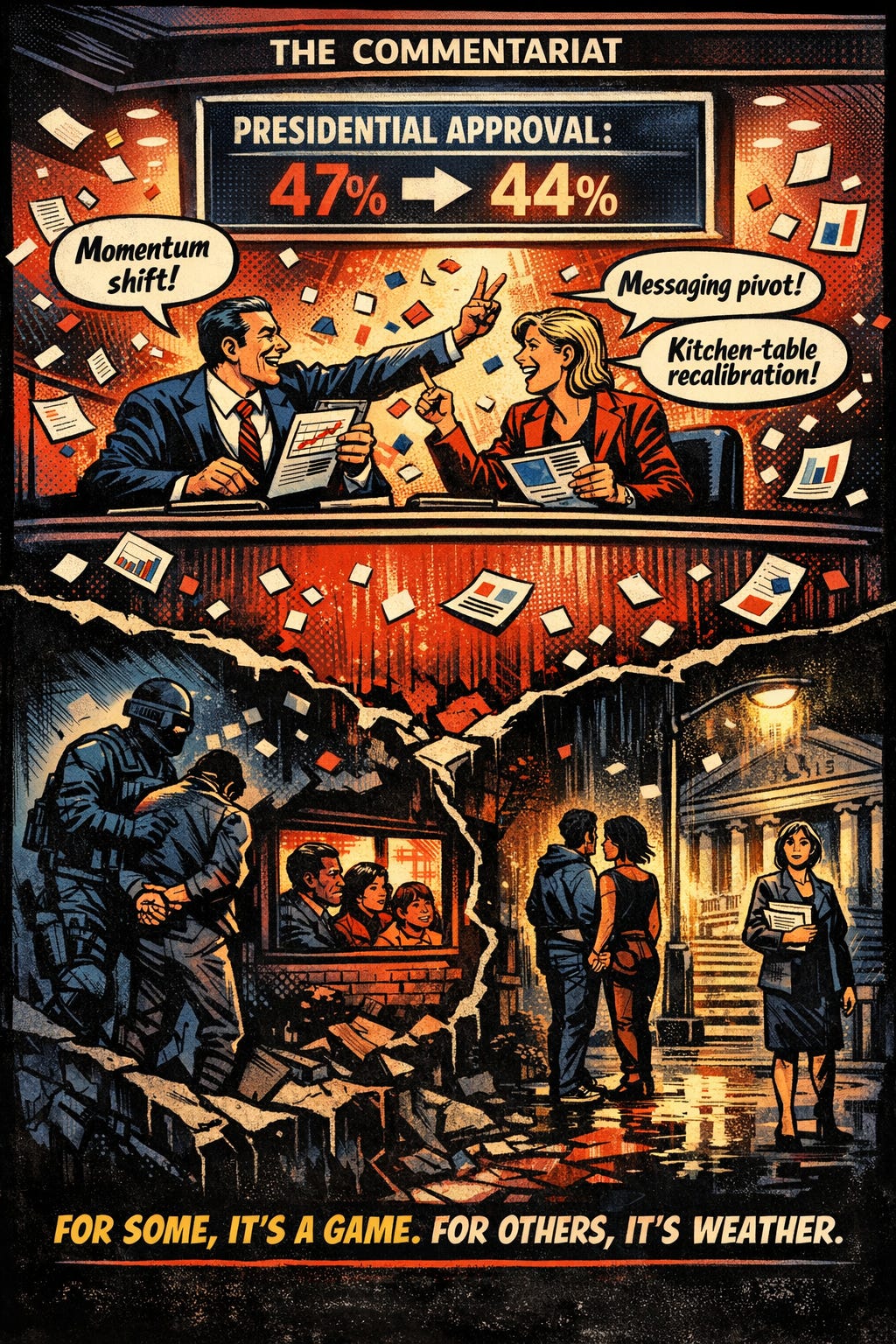
The breathless parsing of marginal approval shifts (up three, down two) presumes a fluid electorate ready to be nudged by clever messaging. That presumption no longer holds. Approval ratings now largely reflect partisan entrenchment. The volatility that once signaled success or failure in governance has been replaced by structural rigidity.
Life is not a game. And the life of the nation certainly is not.
If masked federal agents can detain citizens on camera and approval remains largely sorted by party, then we are not in a moment of ordinary political fluctuation. We are in a moment that demands structural analysis, not scoreboard watching.
Our society insists that we understand this era plainly as a time where institutions are under strain, media ecosystems are siloed, and trust is fractured. The Republic cannot be reduced to weekly approval oscillations.
The old tools are insufficient, not necessarily wrong.
We are living in a political order defined less by persuasion and more by identity consolidation. That reality does not mean public opinion is irrelevant. It means we must measure it and interpret it with sobriety rather than nostalgia.
The moment requires clarity without fantasy, realism without cynicism, and analysis that recognizes that polarization is not a mood swing but a structural condition.
Whether we like it or not, that is the American chapter we are writing.

Enshittification and the Privilege of Looking at American Politics as a Game
Treating American politics like a game is a privilege. One reserved for people whose lives don’t change much when the score does. It’s the privilege of watching elections the way you watch sports: obsessed with momentum, addicted to marginal shifts, comforted by the idea that everything is ultimately a matter of strategy and messaging. But for millions of Americans, politics is not a pastime. It is exposure, risk, and whether your rights survive the season.
We are living through mass enshittification. Not just of platforms or products, but of public life itself, our institutions, our civic trust, our shared reality. And if you step back for a moment and look plainly at what happened at the end of 2024, it’s hard to avoid the simplest reading: America showed it is willing to sacrifice national competence for a misogynistic, homophobic, white supremacist rebel yell. That choice wasn’t random.
It wasn’t just “economic anxiety.”
It was a cultural signal flare.
America has long wanted to believe the Civil War was a historical blunder rather than a moral rupture. It has wanted reconciliation without reconstruction and closure without accountability. And it has spent generations trying to erase the meaning of Black bodies being freed and made citizens, as if that transformation was an inconvenient footnote rather than the central unfinished business of the Republic.