

Polling PTSD
Why the good news doesn't feel like good news.


There is a new poll being discussed today by the New York Times and Siena. It shows, predictably, that the Trump presidency is unpopular. This includes high prices, foreign engagement, and an immigration policy that ranks as his strongest area, even as he still polls below 50 percent. For anyone genuinely invested in peeling off swing voters and building toward the kind of structural change that might secure democracy, this is good news.
But for some reason, it doesn’t excite me.
Maybe it’s that Trump has come back from worse numbers in his first term. Maybe it’s that Amy Walter’s famous final reads were wrong the eve of the 2024 election. Maybe it’s that I have polling PTSD, the residue of living in a political-communications world that treats survey data like prophecy rather than what it actually is…answers attained by obsessively calling people’s cell phones.
Polling PTSD comes from watching the national discourse get absorbed by the running tally while the structural questions of race, class, identitarian hierarchies, and economic malfeasance get pushed to the bottom of the email. The form of horse-race coverage is itself an ideological position dressed as neutral technology. It narrates politics as sport because sport scales. Think about the running tally, the swing-state dashboard, and the cycle-to-cycle update all fit the ad inventory. Structural analysis does not do that. From a business standpoint, this horse race model makes sense. From an intellectually honest one, it is the medium doing politics by other means.
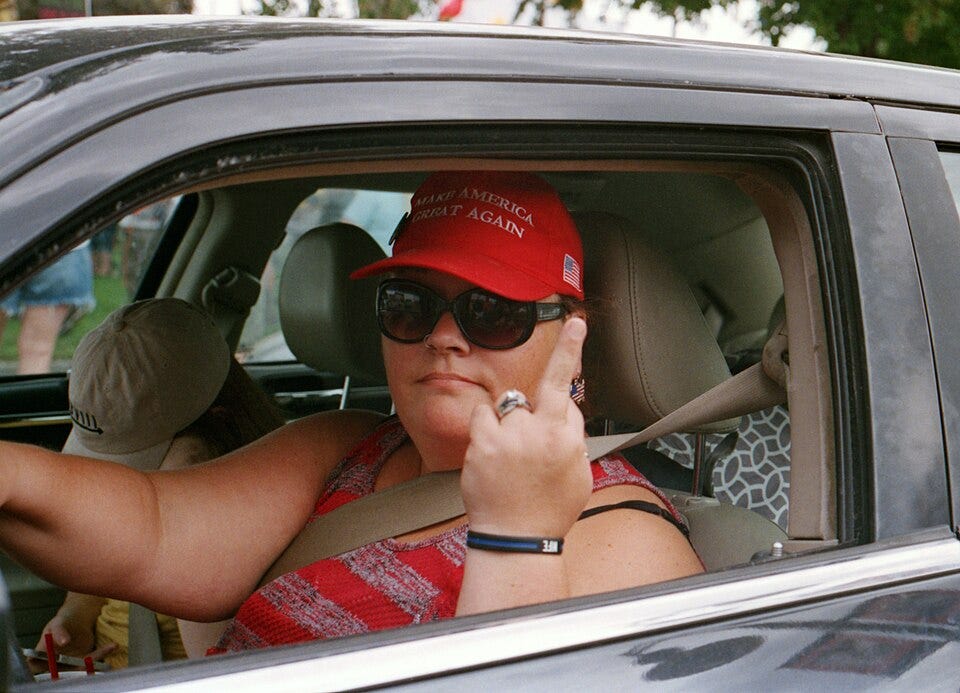
The structural story can’t be narrated like a sport. It looks more like the natural outgrowth of one of two American political traditions, which is the hierarchy-management tradition currently winning against the multiracial-democratic tradition it has always contended with. That contest has a paper trail. The Servicemen’s Readjustment Act of 1944 built the modern white middle class by routing federally subsidized mortgages and college tuition through banks and admissions offices that systematically excluded Black veterans, encoding racial hierarchy into the architecture of postwar prosperity. The compromise didn’t end. It metabolized. It travels through time and follows the empire into the information age, where it now wears MAGA hats and borrows Hayek's vocabulary.
The pattern is iterative, not just historical. The Justice Department announced a $1.776 billion Anti-Weaponization Fund to compensate the roughly 1,600 January 6 defendants (already pardoned), along with other Trump allies who claim Biden-era injury. The figure is not accidental, and neither is the precedent the DOJ cites in its own press release: Keepseagle v. Vilsack, the $760 million class-action settlement for Native American farmers and ranchers systematically denied USDA loans across decades, and also one of the rare cases in which the federal government conceded the reality of structural racial discrimination and paid for it. The DOJ characterizes Keepseagle in scare quotes as a case “alleging racism,” then borrows its mechanism to compensate the people who tried to overturn an election on behalf of a candidate who lost it.
The architecture of civil rights remedies is now being used to remedy white grievance.
Polling cannot anticipate the political meaning of this gesture to voters motivated by either nascent or overt white supremacy, because the gesture is not about persuasion. It is about restitution to a constituency that has been told for decades that it was the real victim. A 37 percent approval rating can tell you many things. It cannot tell you what the remaining 37 percent are being paid, in federal dollars, to stay.
I find myself watching the run-up to the 2026 midterms with a sense of somberness. The Democratic Party’s lack of imagination or, more precisely, its allegiance to corporate storytellers and the dollars that follow them, has produced a much-needed schism within the coalition, even as the material well-being of Americans declines and the Civil Rights project is rolled back in the courts that authorize it, the legislatures that codify it, and the militia movements that enforce it on the ground.
The Never Trump commentariat, professionally invested in narrating Trump-as-aberration, has every reason not to draw the line from Goldwater through Reagan through Bush II to the present.
Drawing it would implicate them.
And that, finally, is the deepest function of the polling obsession: to allow everyone with a stake in the story to talk about Trump without ever having to talk about America.
To obsess over polls and swing voters, then, is to deny the history and therefore to fail to understand Trumpism as a continuation of a conservatism preoccupied with hierarchy management while marketing itself in the borrowed vocabulary of “small government” and “personal responsibility.” The numbers might still move in November. The story underneath them is older than the numbers.


From two days ago:
https://leslyejoyallen.substack.com/p/political-ads-on-you-tube-and-an?r=1hfbq&utm_medium=ios
Serious question, has multiracial/multicultural democracy had any real sustained success anywhere, at any time in history? Because honestly, sometimes it just feels like we are just shoveling shit against the tide no matter how hard we try or what happens to make us think we finally have it solved (Barack Obama, anyone?)