



In my recent writing, I’ve argued against centrism in the Democratic Party, not because I oppose coalition-building or shared ground, but because the current center of gravity in American politics leans center-right. And more importantly, because a new political center is forming, one that reflects today’s realities, not yesterday’s fears.
Political centers aren’t inherently bad. At their best, they create stability, a common language, and shared priorities. But when they calcify around outdated assumptions or are curated for a political moment that no longer exists, they become barriers instead of bridges. Today’s centrist consensus, the one that still dominates donor circles, legacy media, and campaign strategy, doesn’t serve the public as it exists now. It reflects a coalition that once defined political power, but no longer embodies it.
Many of the Democratic Party’s strategic instincts still come from a generation shaped by a different America: post-Reagan, post-Clinton, pre-algorithm. They remember a time when courting “the center” meant holding your base and expanding outward. But now, the demographics and ideological terrain have shifted. That old “middle” doesn’t command the same power, and the communities often treated as the edges, like young voters, working-class voters, and voters of color, are increasingly the core.
That contrast matters. Imagine coming of age in the United States, where the halls of power were even Whiter and more male-dominated than they are today. Where being in the closet was a form of safety. Where immigration was tolerated mainly through a Cold War lens, and the weight of model minority expectations bore down on first- and second-generation Americans. It was a country where the rulebook was strictly enforced for some, but written by those who rarely followed it themselves.
My generation inherited a very different country. We came of age through economic collapse, climate catastrophe, gun violence, mass surveillance, and the unraveling of post-racial illusions. We were shaped by a digital media ecosystem that peeled back the pageantry of traditional politics. We don’t idealize bipartisanship because we see who gets sacrificed for it. We don’t romanticize institutions because we see the inequality they uphold.
So when political strategy aims to preserve a fragile center instead of meeting the urgency of this moment, it doesn’t just fall short, but it actively demobilizes. Not out of malice, but out of habit. The focus on moderation, decorum, and “electability” can inadvertently push away the very people who form the foundation of a winning coalition.
This is how base deactivation becomes systemic. When the energy, ideas, and needs of core constituencies are viewed as risky instead of essential, the result isn’t just strategic inertia, but strategic alienation.
Meanwhile, the GOP has embraced acceleration. They’ve radicalized their base, warped institutions, and forged durable networks of power. Democrats, by contrast, often find themselves stuck in reactive mode, like trying to win over voters shaped by Fox News while under-engaging the communities that actually deliver victories.
And the media plays a defining role. The legacy press still clings to outdated notions of balance, civility, and false equivalence. It elevates pundits whose benchmarks haven’t shifted since the 1990s and rewards narratives that maintain the illusion of a stable center. It’s hard to move forward when the scoreboard is still set to Clinton-era rules.
So no, I don’t believe the future of Democratic strategy should be dictated by nostalgia. Not because those who built it are inherently wrong, but because their maps were drawn in a world that no longer exists. Their experience is valuable, but only if it adapts, if it listens, and if it evolves.
We don’t need yesterday’s playbook in a different font. We need strategies built for the world we’ve inherited, which is broken, burning, and still ours to shape.

History Didn’t Break the GOP. It Revealed It.
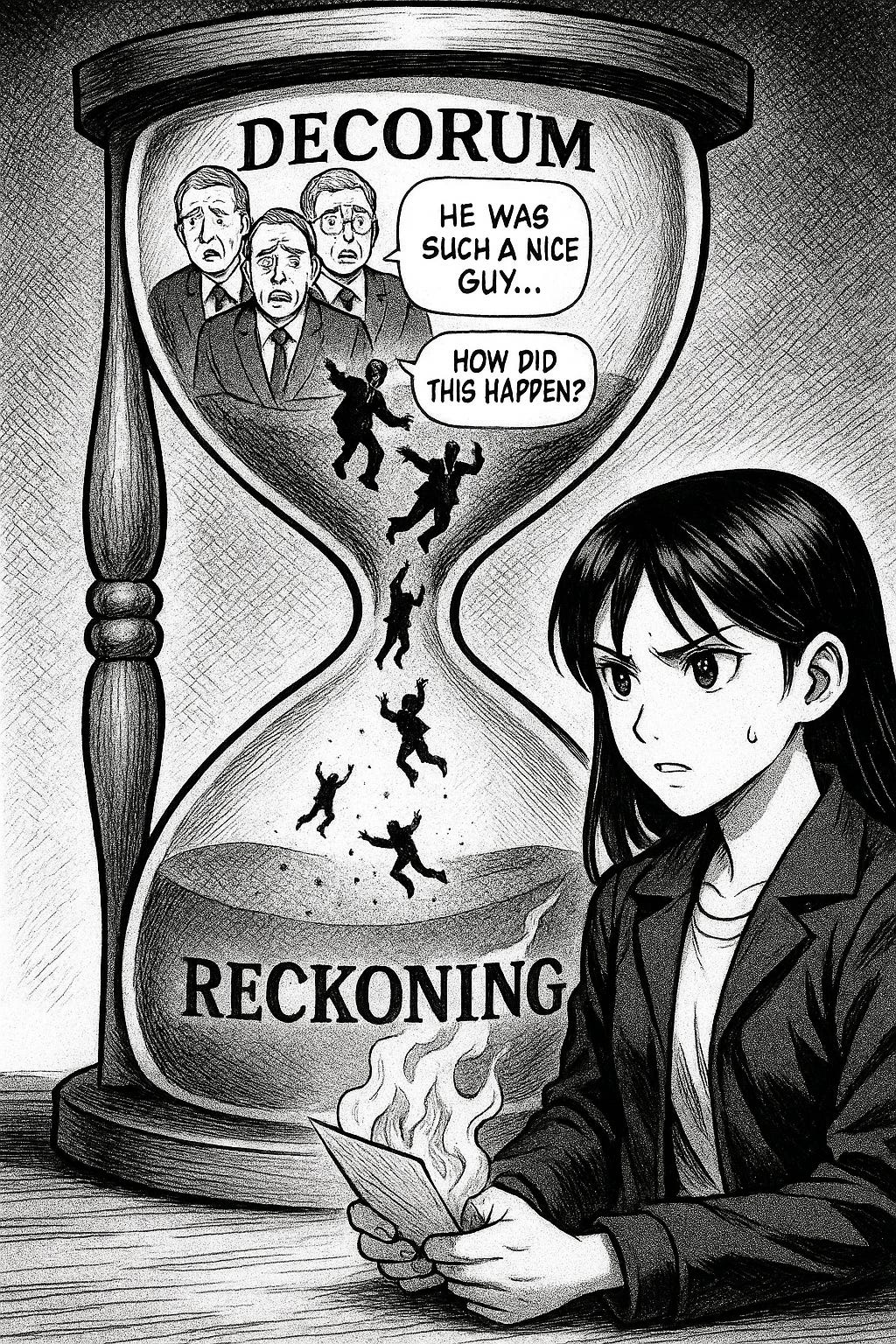
As I’ve studied Never Trump Republicans, many of them Democrats now, I’ve noticed a recurring frame. They often say they were bewildered to see the racist, sexist, and homophobic incentive structures of the GOP personalized and personified by people they once knew as kind, professional, and intelligent.
As I stated above, I’m younger, so I can’t share that experience yet. But I want to offer a possibility: maybe those beliefs were always there, perhaps just latent, private, polite in public. Maybe demographic change in workplaces, in halls of power, in politics, and across the United States just allowed private conversations to become public policy stances, as well as spectacles of radicalized hatred.
