

Between Fear and Fantasy: Longwell and the Collapse of "Serious" Politics
Bret Stephens was half right about Never Trump Republicans...unfortunately.


Ever since The Bulwark has been, as Sarah Longwell described on X, “kicking the DSA hornet’s nest,” there has been a wave of internecine debate within the broader pro-democracy coalition. Some are openly asking how former Republicans can guide Democratic strategy after helping build the very narrative frameworks that Trump now uses to empower his movement. Others argue that there is a sizable bloc of disaffected former Republicans who oppose Trump, but who are just as, if not more, animated by what they perceive as excesses in social and economic justice movements.


Hasan Piker, the controversial Twitch streamer who recently campaigned with Abdul El-Sayed and Summer Lee (to the chagrin of Longwell and opponent Mallory McMorrow), offers a different framing. He argues that the Never Trump Republican constituency is minuscule compared to the broader universe of pro-democracy Americans: those who have long advocated for human rights, those who identified the GOP’s role in incubating those threats even when Longwell herself was a Republican, and younger generations who came of age in the wreckage of both center-right Democratic and Republican governance.
This entire debate leaves me wondering why the pro-democracy coalition seems so intent on eating its own, particularly its talent of color. Is that an implicit admission that America is too structurally racist for those voices to lead, so moderate White voices must carry the fight? If so, that would simply double down on a strategy that has repeatedly failed to defeat Trumpism.
It also brings to mind Bret Stephens and his writing on the limits of Never Trump Republicanism, not because he is reliably correct, but because he may have stumbled into something true.
Bret Stephens was half right, though not for the reasons he thinks. In trying to defend the moral relevance of Never Trump Republicans, he ends up conceding their political irrelevance. And if that constituency is as thin as he suggests, then building a pro-democracy strategy around it begins to look less like pragmatism and more like misdirection. What he treats as a tragic decline of principled conservatism is, in reality, an exposure of its limits. Never-Trump Republicanism was never a mass political force; it was an elite refuge, a place to register dissent against Trump without fully confronting the ideological throughlines that made him possible.
That unresolved baggage then becomes the baggage of the broader pro-democracy coalition, particularly for those who never felt the need to separate Reagan from Trump, and instead see them as part of a continuous ideological arc.
As the Michigan Senate race between Abdul El-Sayed, Haley Stevens, and Mallory McMorrow heats up, we are seeing a familiar pattern, one that echoes dynamics from other contests involving candidates like Jasmine Crockett. Outspoken candidates of color often find themselves navigating an uneasy relationship with a Democratic establishment that includes figures from The Bulwark, Pod Save America, and the consultant class orbiting voices like James Carville and Paul Begala.
No one will say outright that America is too racist for political visions led by young people of color, but the behavior often suggests it. Narrative sabotage, selective amplification, and what some bluntly call “ratfuckery” function as proxies for that unspoken belief.
In El-Sayed’s case, his outspoken criticism of Israel and its influence on American politics, particularly as it relates to U.S. foreign policy and violence against Muslim populations, adds another layer. Those positions make him uniquely vulnerable to well-funded opposition campaigns, which, in turn, spill over to target adjacent figures like Hasan Piker. That means resurfacing his most inflammatory comments, sometimes irresponsibly made, yes, but also frequently stripped of context to discredit not just him, but the broader coalition he energizes.
The result is a familiar cycle: alienating highly engaged constituencies who have watched the GOP—and the Trump movement in particular—openly dismiss their histories and personhood, while being told to respond with calm, technocratic messaging rooted in a 1990s political imagination that refuses to name what is plainly before us. There is an elephant in the room, and it’s wearing a Klan robe.
Sarah Longwell, saying Arab and Muslim voters are having a temper tantrum over Palestine in January 2024:
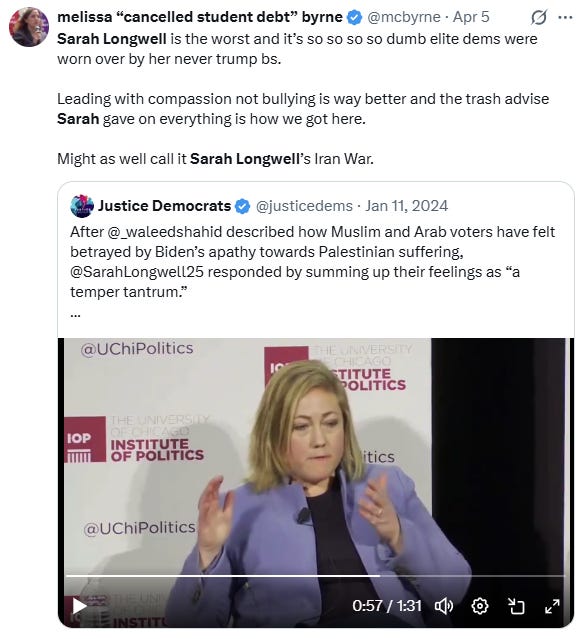
If leaders within the pro-democracy coalition, particularly those tethered to donor networks, including funding streams that have historically intersected with Koch-backed political infrastructure, centrist career incentives, and D.C.-centric abstractions of the American public, believe that the electorate cannot accept candidates of color with clear ideological commitments and an unfiltered tone, they should say so plainly. What they should not do is wage quiet campaigns of narrative containment while pretending to be neutral.


What they should not do is wage quiet campaigns of narrative containment while pretending to be neutral.
This raises a deeper question: Is there actually a meaningful constituency for the Never Trump Republican style of politics?
The prominence of The Bulwark might suggest there is. But recent electoral history complicates that assumption. Voters did not abandon Trump over institutional arguments or appeals to moderation. In fact, many remained loyal through inflation, scandal, and democratic backsliding. The attempt to frame Kamala Harris through a more neoconservative lens, foregrounding figures and rhetoric associated with that tradition, did not produce a winning coalition.
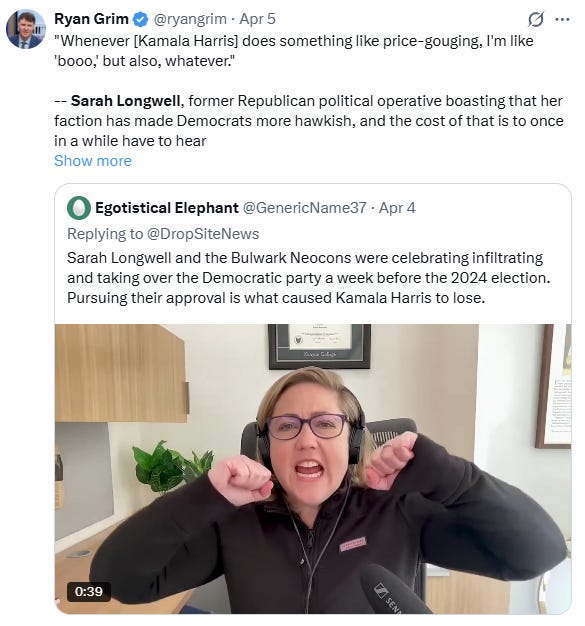
And despite months of commentary suggesting that cultural issues, particularly around trans rights, were the central liability, the data tells a more complicated story about turnout, coalition-building, and political identity. The idea that moderation alone is a reliable path to victory has been increasingly challenged by political scientists, who find its electoral benefits inconsistent or overstated in the current era.
Maybe Bret Stephens was right in name only: the Never Trump Republican brand has lost its luster.
More importantly, it may have distracted from a more honest reckoning, one that names American conservatism not as a corrupted ideal, but as an ideology with a throughline. From William F. Buckley Jr.’s defense of segregation at the height of the civil rights movement to later battles over queer rights and suggestions of an “AIDS tattoo,” there has long been a tension between the language of freedom and the preservation of hierarchy. Buckley later recanted some of these positions, but the record remains part of the tradition.
Perhaps conservatism, at its core, is less about principle than instinct, an instinct to preserve hierarchy, even in its harshest forms, no matter how much intellectual polish is applied.
Those are my thoughts.
Have a great weekend and Go O’s.

Good work, Stew. Lots to think over. IMHO there is an indelible through line in post Reconstruction Republican politics. Arguably, Buckley-ism was a strategic papering over of John Birch-ism. Ironically, Buckley became an “in-house” Republican progressive.
I think you are insightful. I caution you to be more skeptical of abstract(ing) terms and labels - from all sides. I wish I could put that better. I hope you can get my intent.
I maintain my paying subscriptions to you and to the Bulwark.I get where both of you are coming from.
Very thoughtful analysis. Thank you.