



Presidents fighting with the Federal Reserve is nothing new. Presidents using the machinery of the Justice Department while doing it is.
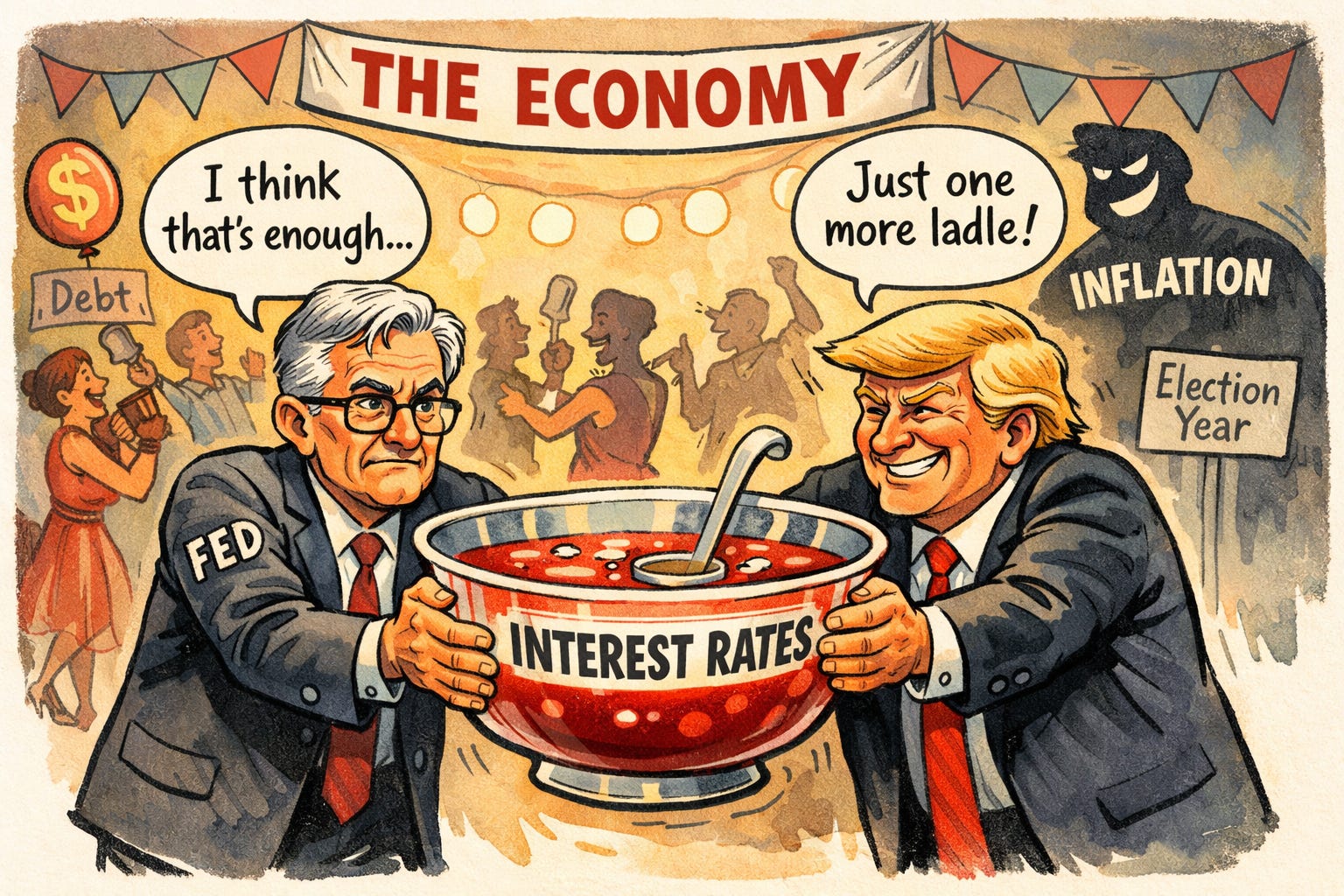
The Federal Reserve’s power over interest rates has always made it a political target. Cheap money looks like growth. Growth looks like competence. And competence buys time with voters. That incentive structure hasn’t changed much in a century.
What has people uneasy this week is the news that Donald Trump’s supposedly independent Department of Justice has opened an investigation into Jerome Powell over his congressional testimony about renovations to the Federal Reserve building. Supporters call it oversight while critics see institutional pressure applied sideways.
To understand why this feels familiar (and why it also feels different), it helps to rewind to a moment when Americans believed they could have everything at once.
In the 1960s, the country genuinely thought it could afford both guns and butter. That belief shaped the presidency of Lyndon B. Johnson, who expanded social spending at home while financing an increasingly disastrous war in Vietnam. The gamble wasn’t just moral or political. It was an economic one, assuming that voters wouldn’t be forced to confront the bill.
That assumption shaped policymakers' thinking about the Federal Reserve.
Economists like Alvin Hansen reflected the era’s confidence that Washington could coordinate growth, employment, and stability if its institutions worked together. Hansen worried less about technical models than about fragmentation. An overly independent Fed, he feared, could force painful tradeoffs into public view before elected officials were prepared to own them.
In other words, inflation wasn’t just an economic problem.
It was a political one.
That tension became personal in Johnson’s relationship with Fed Chair William McChesney Martin. As later reporting, most memorably captured in a Marketplace article, made clear, Johnson leaned on Martin relentlessly to keep interest rates low. Higher rates would have made the Vietnam War's costs unmistakable, raising borrowing costs and puncturing the illusion that ambitious domestic programs could proceed without consequence.
Martin resisted. He believed inflation would eventually force a reckoning and that the Fed’s job was to ensure it happened sooner rather than later.
Johnson heard obstruction, not prudence.
The conflict culminated in Johnson summoning Martin to his Texas ranch, where the president reportedly berated and physically intimidated the Fed chair. The episode mattered less for its theatrics than for what it revealed, which was that Johnson wasn’t asking for analysis but for political cover.
Under pressure, Martin delayed some of the tightening he believed was necessary. But once Johnson removed himself from the political equation by announcing in March 1968 that he would not seek reelection, the Fed sharply raised interest rates within weeks.
The timing told the story.
In hindsight, even Hansen’s call for coordination looks fragile. Confidence in economic stewardship slid toward coercion once political costs mounted. Johnson’s behavior wasn’t a meeting of minds; it was an attempt to delay accountability for a war he privately knew was both morally and economically destabilizing.
Whether the inflation of the late 1960s unfairly discredited Keynesian economics and cleared the path for Milton Friedman’s corrective is a debate best left unresolved.
What matters is this: presidents clashing with Federal Reserve chairs is not new. What is new is the routing that clashes through the Department of Justice, an institution built for legal accountability, not economic disagreement.
The fight has always been about who pays the political price for governing.
What’s changed is how aggressively presidents now try to make sure it isn’t them.
References
Hansen, Alvin H. “INFLATION and The New Economics.” Challenge 15, no. 2 (1966): 5–41. http://www.jstor.org/stable/40720897.
Marshall-Genzer, Nancy. “A President and His Fed Chair Clash. Sound Familiar?” Marketplace, October 27, 2020. https://www.marketplace.org/story/2020/10/27/a-president-and-his-fed-chair-clash-sound-familiar.

If the free section traced a familiar conflict between presidents and the Federal Reserve, the present moment marks a shift in how that conflict is being waged.
What stands out is not presidential frustration with institutions (that is old), but the growing comfort with using institutional power directly to pursue political ends. We have seen versions of this logic applied to prosecutors, law enforcement officials, and statistical agencies. Each episode can be defended in isolation, but together, they form a pattern that is harder to dismiss.
What feels different is the lack of pretense. Previous administrations quietly strained norms, often denying they were doing so at all. Today, institutional pressure is exercised openly, framed as accountability rather than interference. Politics becomes less a contest over policy than a struggle over legitimacy.
In that environment, the president appears to operate with a sense of mandate that sits uneasily alongside older constitutional expectations.
A paid subscription gets you:
Full access to the archives
The ability to comment and join the conversation
Stew’d Over, and other bonus daily newsletters!
Live Ask Me Anything sessions with paid readers
This independent work is sustained by readers who want more than headlines and hot takes.
