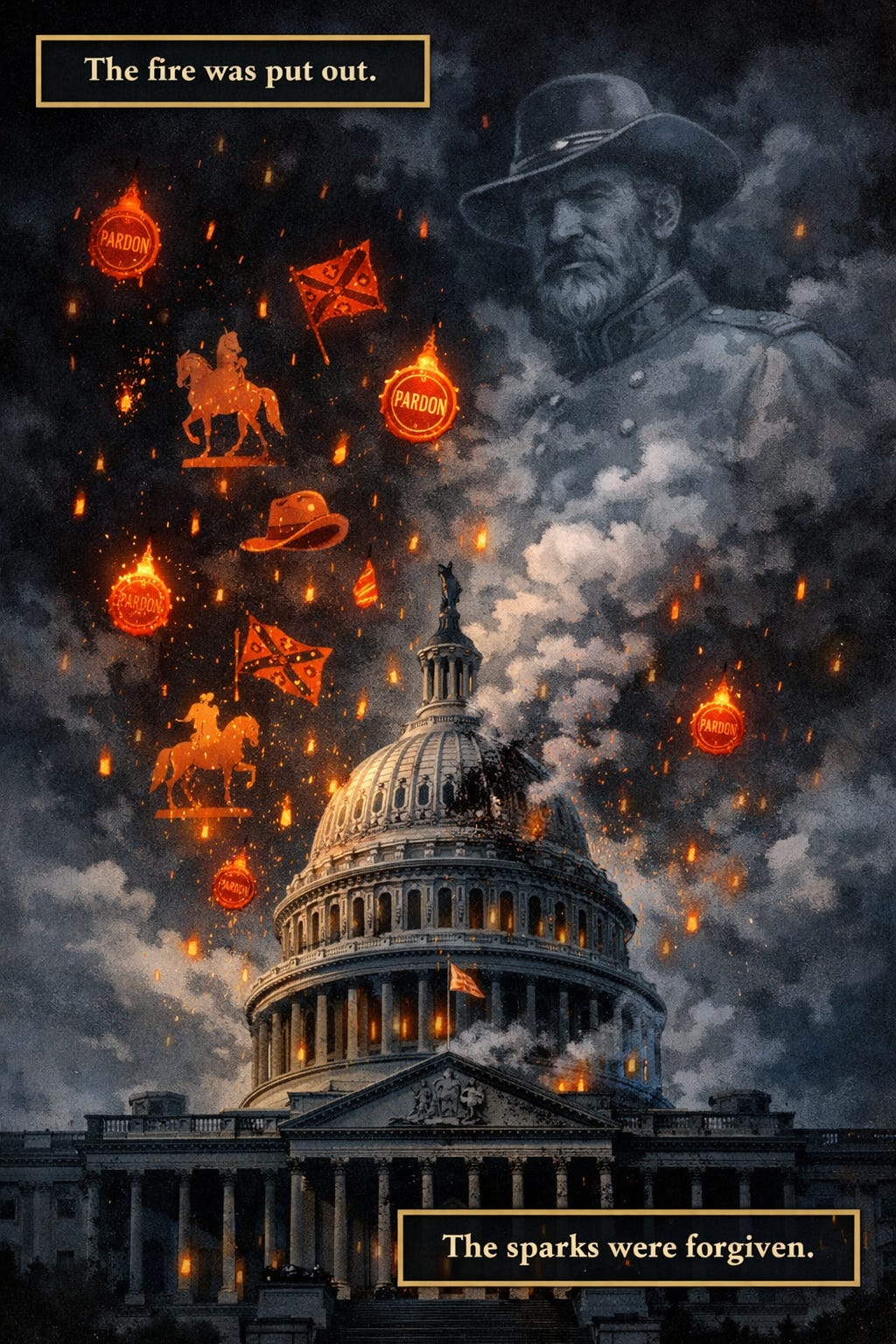


Today, I’m writing less about scholarship and more about a feeling or the sense that we are living inside a loop. Not history repeating itself in some mystical way, but a pattern replaying because its root causes were never addressed.
It feels like 2017–2021 all over again. Only this time it’s louder, more consolidated, and less restrained. We are still avoiding the structural question of why this administration can break so many rules and get away with it.
Why does a particular identity cult find such fertile ground here? Why does power centralize so easily while outrage dissipates into pundit fog?
We are still told that the problem lies in tone. In the way that activists are being too loud. In the way academics are being too theoretical. In the way people of color name structural realities that supposedly frighten a mythical median voter. The lesson, we are told, is that democracy would function smoothly if only the margins would quiet down.
But that diagnosis treats symptoms as causes.
If Trumpism were merely a backlash to excess rhetoric, it would not return stronger each time. The ground is fertile because the soil was always prepared. Refusing to examine the structural conditions that make Trumpism inevitable, given the real story of American development, ensures that something like it will rise again, perhaps more efficiently.
The deeper tension is that democracy in a genuinely multicultural society requires a baseline of shared social protection and mutual recognition. But the American Dream was built alongside racialized hierarchy, territorial conquest, and economic stratification so extreme that solidarity itself becomes fragile. For many Americans, democracy has historically meant status preservation more than shared governance.
That is not a glitch.
It is a design inheritance.
We avoid this because we prefer the myth. We were raised in one of the most successful national marketing campaigns in human history, which told a story that fused Enlightenment rhetoric with empire, and industrial might with moral exceptionalism. We learned to see the United States not as a nation among nations, shaped by power and hierarchy, but as a providential experiment immune to the darker currents of history.
But we are not immune. We are a nation built through conquest, exploitation, aspiration, and contradiction, like many others before us.
You see it in the geographic segmentation of American life: manicured suburban cul-de-sacs insulated from structural decay; urban cores burdened with concentrated disadvantage; rural communities folded into grievance narratives. These are policy outcomes and not natural divides. They are spatial manifestations of hierarchy.
And when those hierarchies are challenged, when demographic and cultural shifts unsettle long-standing status arrangements, the cycle restarts. Fear is mobilized as solidarity fractures and institutions bend.
The question is not whether America has an original sin in some theological sense. It is whether the nation was structured around apartheid logics, formal and informal systems designed to distribute power unequally, and whether those logics were ever fully dismantled.
If they were not, then repetition is not destiny.
It is inertia.

Insurrectionists Punished in Korea
Anytime I read an article about another country punishing elected leaders for being connected to an insurrection, I get a dark feeling.