

A Sort of Autopsy?
Voting Rights, the DNC, and Denial.

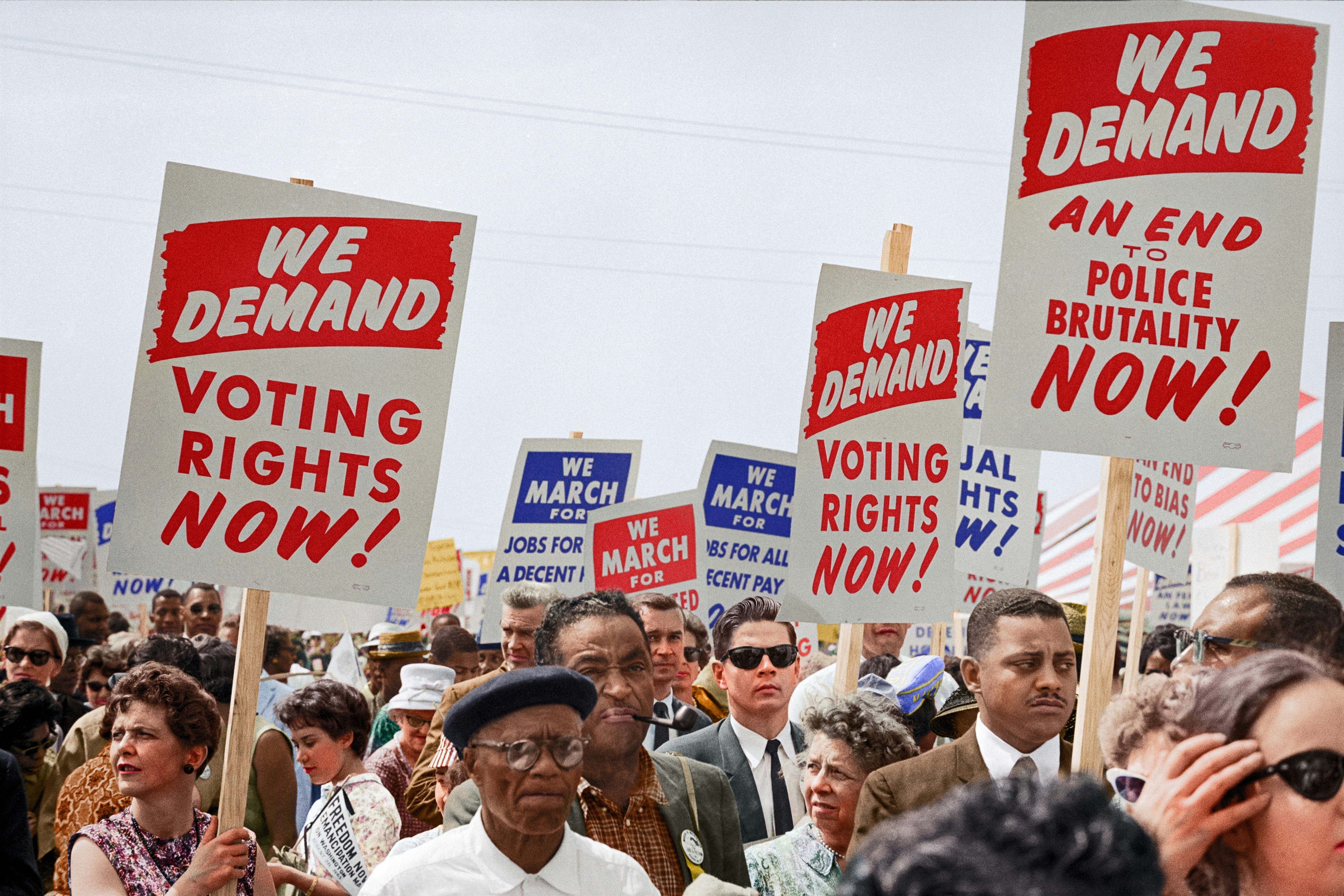
I took a break from writing after the Voting Rights Act was gutted, again. It was a heartbreaking display, and I had a feeling it would be met with the same milquetoast centrist call for Democrats to reach out to more Trump voters rather than reckon with the fact that this destruction of civil rights protections is one of the central tenets of the Trump era, and that appealing to Trump voters would require Democrats to offer a similarly destructive vision.
Still, the tide of current events continues to pull us forward. We are now living in an America where the structural sin of our founding continues to strike back, no matter how much exceptionalist mythology the center-right and some center-left punditry push into the national conversation. It demands that we see connected instances of racial policy violence not as aberrations from a tiny minority, but as expressions of the structural violence that has always undergirded American power relations.
I have been highly critical of The Bulwark lately. After following the publication since its inception, a pattern has become clear: the publication engages in what I would call a half-reckoning with what the conservative movement actually was and why Trump is its most effective president and a natural outgrowth of the Goldwater-to-Bush continuum. I wrote about the toxicity that has always lived inside the narrative of noble conservatism. That narrative makes it impossible to see the present clearly because it requires preserving a story about what the conservative movement has been, rather than grappling with what it actually defended.
The comparison I keep returning to is the Lost Cause. The Lost Cause was not a crude or stupid mythology. It was sophisticated and emotionally resonant, allowing Americans to feel good about a history they could not actually defend on the merits. It constructed a noble narrative of the Confederacy and the antebellum South that smoothed away slavery, racial hierarchy, and the violent defense of both, replacing them with a story about honor, tradition, and a regrettable war. In doing this work, it prevented a genuine reckoning with what had actually happened and what continued to happen under Jim Crow.
The Bulwark is doing something structurally similar.
It is constructing a noble narrative of the conservative movement, one that is procedural, civic, and defends democratic institutions, which allows its coalition to preserve a story about conservatism without engaging with what the movement was actually defending: the structural hierarchies of race, economics, and power that have always been central to American politics. Trump isn’t an aberration from that movement. He is what emerges when you stop pretending the hierarchy-defense has to wear the costume of civility.
You can watch this myth operate in real time. When the Supreme Court decided Louisiana v. Callais on April 29, it did not announce that it was ending the Voting Rights Act. It struck down a map with two majority-Black districts and called the act of drawing them the real discrimination, leaving Section 2, as Justice Kagan wrote in dissent, "all but a dead letter." The hollowing is renamed colorblindness, and the sin is recast as the remedy. And then the cascade: within two weeks, the Court cleared the way for Alabama to use a map a lower court had already found racially discriminatory, and refused to pause its own Louisiana order while states openly redrew districts as partisan proxies. This is not the structural sin as a metaphor. It is the structural sin, a mechanism functioning exactly as designed, narrated all the while as something else.
But to be human is to live in a world of myths. That can be the hardest thing to contend with as a writer, recognizing that the work of breaking one myth is often the work of insisting on another, or at minimum, on a more truthful story. The question is whether we have the honesty to tell it.
The Autopsy That Wasn’t
Weeks after the structural sin was busy striking back, the Bulwark published a different kind of document, one that, in its own way, demonstrates how the center processes a loss it doesn’t want to fully understand.
If the Lost Cause was a story Americans told to avoid reckoning with what the Civil War was about, the campaign autopsy is the story political professionals tell to avoid reckoning with what an election was about. Rob Flaherty’s long-form essay on what went wrong in 2024 is a more honest and more self-aware version of that genre than most, but it is still that genre. It is a piece of writing built to explain a defeat in the vocabulary of brand, coalition, and tactics. These are capacious categories that can hold an enormous amount of evidence without ever having to name the evidence. And what the evidence is, in Flaherty’s own telling, is a campaign fought and lost on a terrain of racialized and gendered appeal that he documents in granular detail and then declines to call by its name.
This is the same half-reckoning. The Court can hollow out the Voting Rights Act and call it colorblindness; a campaign strategist can catalog every coded attack on a Black woman candidate and call it a branding problem. In both cases, the structural truth is fully visible in the account itself. It has simply been filed under a heading that lets the author look away from it.
There is a self-reflective beauty in Flaherty’s writing, including at the end when he admits that his job should not exist. And to his credit, he goes further than most are willing to: he names the coalition problem directly, calls it an “up-down” issue rather than a “left-right” one, and argues that what Democrats need is economic populism with teeth and “real contempt for a status quo we are arguably part of.” He walks most of the way to the door. But something still felt missing in this entire analysis, and where the analysis stops turns out to be exactly where the conservative movement’s culpability would have to begin.
The Trump campaign wasn’t that sophisticated. There were reports of disorganization at the time. For example, Tim Alberta’s reporting in The Atlantic described a campaign at war with itself and a candidate engaged in repeated acts of self-sabotage, and that’s on top of the fact that he was running in front of a courthouse.
And it still won.
That, on its own, should tell you something. If a disorganized campaign won on this terrain, then the terrain itself was doing the work, not the tactics. The campaign utilized Trump’s bombastically incendiary style to paint Harris in ways that were deeply misogynistic and racist. He infamously claimed Harris “happened to turn Black” at the National Association of Black Journalists convention, and he called Harris dumb multiple times.
That strategy worked, as the centrists in the Harris campaign worked to discourage people who would have preferred a more race- and gender-conscious campaign. And here is the thing about Flaherty’s essay: the evidence is all already in it. “She cares about liberal shit, not you.” The trans ad. The “girls and gays” reputation of the KamalaHQ account. The working-class men are peeling away. He documents the entire terrain of coded racial and gendered appeal in granular, honest detail and then files all of it under “brand,” “coalition,” and “tactics,” categories capacious enough to hold the evidence without ever having to name it. That is not an oversight. It is the same half-reckoning the Bulwark performs on the conservative movement itself. The symptom is described in fine detail precisely because the vocabulary is built so that the diagnosis is never reached. Flaherty also gives little space to how the fallout from the Biden administration’s Israel policy helped to deactivate the Democratic base, the base that doesn’t quite exist in the idyllic world of the Never Trump conservative.
By not focusing on the identitarian extremism that Trump continues to tap into, the political operatives rehashing 2024 like it’s a gameboard (rather than taking in a structural lesson about American unexceptionalism) will continue to offend people who have had to watch rampant racism and sexism with little reproach over the last decade.
Before the autopsy, though, it’s worth watching the half-reckoning happen in real time and not as a published position, but as a live conversation, because that’s where you can actually see the moving parts.
On a March 25, 2025 episode of The Next Level, JVL did something unusual for the Bulwark where he narrated his own late recognition of race. Tim Miller added to the conversation by describing his experience sitting on a panel of mostly Black attendees in New Orleans who responded to him like, “welcome to the club, brother. We’ve been here.”
From there JVL asked a genuinely sharp question: whether someone like Wes Moore, who has carried “two truths” about America his whole life, might be better suited to this moment than those just now discovering the second one. It is one the most honest thing I’ve heard a Bulwark host say, and it walks right up to the door.
But then watch what happens to the question when Sarah answers it.
What Sarah says isn’t wrong. Jews, Asians, gay people, women — every group she names has a real relationship to American exclusion. But a frame isn’t a fact-check. JVL asked a question that put the African American experience at the center and Sarah’s answer redistributes it until there is no center at all. That dispersal does specific work. The African American experience is not one item on a list of American exclusions. It is the one the structures were built around. The constitutional contradiction Sarah herself cites, “everybody except landowning white men,” which was structured around slavery until suffrage was granted to all white men as the frontier’s demographic’s changed and expanded. The Senate and the Electoral College are the machinery that filters popular will. It is shaped in their decisive moments by the management of Black political power. The Voting Rights Act exists because of that lineage. Callais guts it inside that same lineage. She flattens “the African American experience” into “everyone has had it hard,” and you haven’t been more inclusive and you’ve got a pundit who cut the through-line that explains why American policy keeps producing the same shape of result.
And cutting that through-line does one more thing, the thing that matters most. It quietly converts racism from a feature of how power is arranged into a flaw that happens to sit in some people’s hearts. Once it’s an everyperson story, racism becomes a moral failing distributed at random some have it, most don’t, it’s regrettable, it isn’t the architecture. But the frame JVL’s question keeps intact is the one where racism is encoded in maps, in apportionment, in which districts are allowed to exist and therefore drives and rewards behavior without anyone needing to feel a flicker of conscious animus. A voter doesn’t have to hate anyone to benefit from a map drawn to dilute Black votes. The structure does the motivating. That is why the African American-centered frame has power and Longwell’s dispersed one doesn’t and is arguably ahistorical. One can account for racism that is never said out loud, and the other can only see it when someone uses a slur.
And then there’s the Klan.
Sarah reaches for it as proof of the self-correcting system by saying they “owned everything in the 20s,” and “10 years later, they didn’t own shit.” The second Klan did collapse in the late 1920s, but not because America reasoned its way out of it. It collapsed under scandal and the criminal corruption of its own leadership. More to the point though, the Klan losing its membership rolls did not return political power to Black Americans.
The 1920s and ‘30s were the deep interior of Jim Crow with disenfranchisement and segregation and racial terror that ran perfectly well without the hoods, because they were written into state law and underwritten by federal silence. The Klan was a costume the structure wore. When the costume came off, the structure kept walking. Sarah reaches for the Klan to show the bad thing went away, and the actual history shows the bad thing outlived its most famous disguise by two generation, and is, as the first half of this newsletter argued, being refitted right now.
The example doesn’t support the optimism. It is actually evidence for the opposite.
The test of how much Trump can stick to his chaotic style while delivering white male supremacist wins is ongoing, even as the economy continues to sink under neoliberal wealth transfers.
I applaud Flaherty for producing this piece of writing. He did the reporting but he just won’t read his own notes. And that is because it seems to emanate from the same genre of political writing that is entirely incapable or unwilling to examine how the nation’s original sin can lead to its political unraveling, and how, no matter how many bells and whistles are added to a campaign, that dark truth of America will never change.
I would love to be wrong.

Spot on. I have been bagging on the folks at The Bulwark recently as well. They really want to be allies as long as the left agrees to meet them in their (purported) center-right. As much as they decry the shifting of the Overton window, they like it centered on their preferential residence.
Your notes on the shambolic positioning that Sarah Longwell smears to try to do the "not all men" with the racial aspect is particularly troubling.
I fault the spineless Democrats for not being aggressive and proudly progressive at least economically, America supports universal health care and education, but the donor class doesn't.
The donor class wants to not pay taxes, and to privatize everything .
But when it comes to Equal rights and voting rights, there is one racist on the Supreme Court which confounds me: Clarence Thomas.
He said on ascension to the court, that " you made me miserable for 43 years, not I am going to make you miserable for 43 more"
I wonder what that "you" ism it certainly wasn't the white racists, the confederates? He is the Stephen, the house negro, in Django Unchained.